

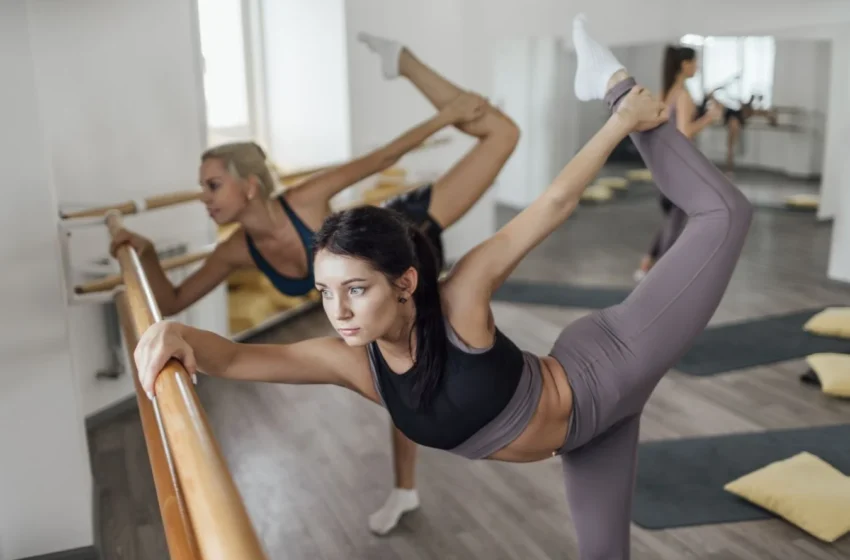
Quick and Effective Pilates Bar Workout for Busy Schedules
Do you ever finish a busy day and realize you have almost no time left for exercise?
That is where a Pilates Bar Workout can be especially useful. A Pilates bar is compact, relatively easy to store, and can add resistance to movements that would otherwise rely mainly on body weight.
Unlike a long gym session that may require travel, setup, and several pieces of equipment, a Pilates bar can support a focused workout at home.
It can be used for squats, rows, presses, curls, lunges, core exercises, and controlled Pilates movements.
However, the goal is not to rush through dozens of exercises. The real advantage comes from combining controlled resistance, good posture, steady breathing, and efficient exercise selection.
In this guide, you will learn how to build a quick Pilates bar routine, which exercises to prioritize, how to modify movements, and how to fit the workout into a busy schedule.
What Is a Pilates Bar Workout?
A Pilates Bar Workout uses a lightweight bar connected to resistance bands to create tension during exercise.
Unlike a traditional barbell, the Pilates bar does not usually rely on heavy plates. Instead, resistance comes from elastic bands that stretch as you move.
This makes the equipment relatively compact and convenient for home workouts.
Depending on the design, the bar can be used for:
- Squats
- Lunges
- Rows
- Shoulder presses
- Biceps curls
- Chest presses
- Glute exercises
- Core movements
- Mobility exercises
The resistance can vary based on the band, body position, range of motion, and how far the band is stretched.
Why it works well for busy people
A major advantage is simplicity.
You can keep the bar in a closet or under a bed, take it out quickly, and begin a workout without setting up a full home gym.
That can remove one of the biggest barriers to exercise: friction.
If starting a workout requires 20 minutes of preparation, you are more likely to skip it.
If you can begin within a few minutes, consistency becomes easier.
How a Pilates Bar Builds Full-Body Strength
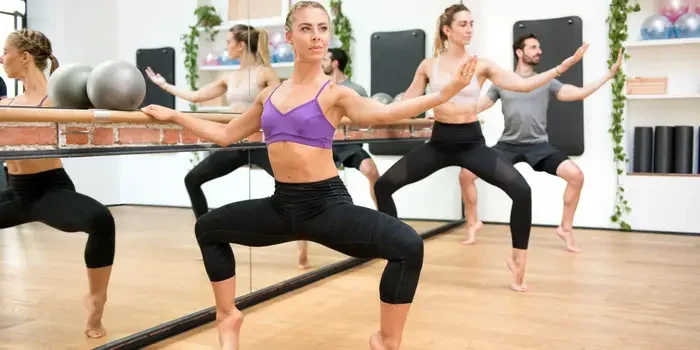
A Pilates bar can create resistance in both the upper and lower body.
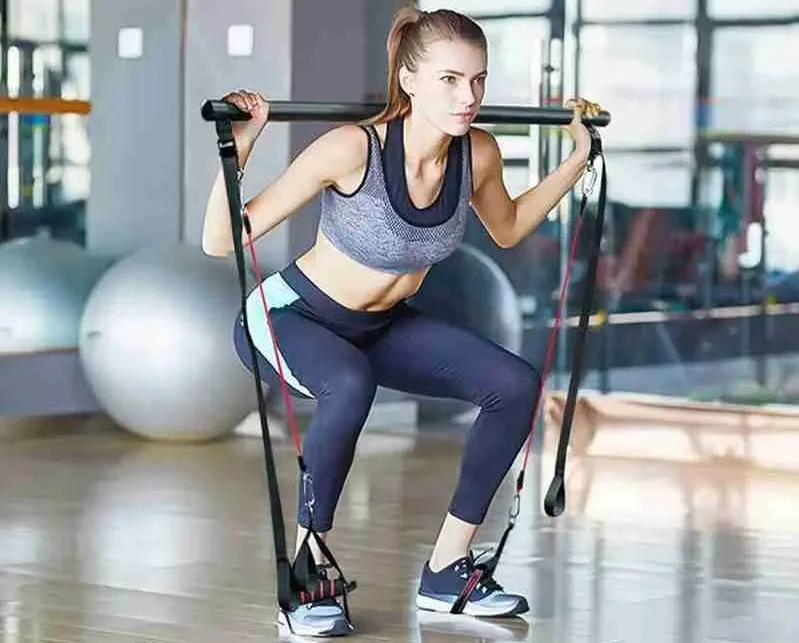
For example, standing on the resistance band while holding the bar can turn a basic squat into a resistance exercise.
Similarly, anchoring the band securely can allow you to perform pulling or pressing movements.
The equipment is particularly useful for muscular endurance and general strength, although it does not provide the same loading potential as a full set of free weights.
The role of progressive resistance
Your body adapts when it receives an appropriate training challenge.
With a Pilates bar, progression can come from:
- Increasing band resistance
- Performing more controlled repetitions
- Increasing time under tension
- Improving range of motion
- Using more difficult exercise variations
- Reducing rest periods when appropriate
However, progression should be gradual.
If your technique starts to break down, the resistance is probably too high or the movement is too difficult.
A 15-Minute Pilates Bar Workout
If your schedule is extremely tight, you do not need to skip exercise completely.
A focused 15-minute workout can target several major muscle groups.
Warm-up: 2 minutes
Start with:
- Shoulder rolls
- Gentle squats
- Arm circles
- Hip movements
- Easy marching
The purpose is to prepare your body rather than exhaust it.
Main workout: 10 minutes
Perform each exercise for approximately 40 seconds, followed by 20 seconds of transition.
Complete two rounds.
- Pilates Bar Squats
Stand on the resistance band and hold the bar near shoulder height.
Lower into a controlled squat, then stand while maintaining an upright torso.
- Bent-Over Rows
Hinge at the hips while keeping your back neutral.
Pull the bar toward your lower ribs, then slowly lower it.
This targets the upper back and arms.
- Standing Shoulder Press
Hold the bar around shoulder level.
Press upward without shrugging your shoulders.
Lower slowly.
- Biceps Curls
Stand on the band and hold the bar with your palms facing upward.
Curl the bar toward your shoulders.
Keep your elbows relatively stable.
- Glute-Focused Lunges
Step one foot backward and lower into a controlled lunge.
Keep your front knee aligned with your foot.
Alternate sides.
Cool-down: 3 minutes
Finish with gentle breathing and comfortable stretches for the hips, shoulders, chest, and legs.
This short session is not a replacement for every type of exercise, but it can provide a practical movement break during a busy day.
Pilates Bar Workout for the Lower Body
Your lower body contains some of the body’s largest muscle groups.
That makes squats, lunges, bridges, and hip-focused movements useful choices when time is limited.
Pilates Bar Squat
The squat is one of the most efficient exercises because it trains several lower-body muscles simultaneously.
To perform it:
- Stand on the resistance band.
- Hold the bar near your shoulders.
- Keep your feet stable.
- Push your hips backward.
- Lower into a comfortable squat.
- Drive through your feet to stand.
Keep the movement controlled.
You do not need to squat extremely deeply if doing so compromises your alignment.
Pilates Bar Deadlift
A resistance-band deadlift can train the glutes and hamstrings.
Stand on the band with your feet around hip-width apart.
Hold the bar and hinge at your hips.
Keep your spine neutral as you lower the bar, then drive your hips forward to return to standing.
Think hip movement, not bending from the lower back.
Pilates Bar Workout for the Upper Body
The bar can also create a balanced upper-body session.
Standing Row
If your equipment allows a secure anchor point, a resistance-band row can train the upper back.
Pull the bar or handles toward your body while keeping your shoulders controlled.
Pause briefly before returning to the starting position.
This exercise is useful for people who spend much of the day sitting because it trains the muscles responsible for pulling the shoulders backward.
Chest Press
With a secure anchor behind you, the bar can be used for a resistance chest press.
Push forward while maintaining control.
Do not allow the band to snap the bar backward during the return phase.
Shoulder Press
The shoulder press is another efficient movement.
However, people with shoulder limitations should use an appropriate range of motion rather than forcing the arms overhead.
Good resistance training should challenge you without creating unnecessary joint stress.
Pilates Bar Workout for the Core
The core should not be treated as a separate body part that only gets trained with crunches.
Your core works whenever you need to stabilize the trunk while your arms or legs move.
That makes the Pilates bar useful for standing core exercises.
Standing Anti-Rotation Press
Secure the resistance band to a stable anchor.
Stand sideways to the anchor and hold the bar in front of your chest.
Press it away from your body without allowing your torso to rotate.
Your abdominal muscles work to resist the rotational force.
This is called anti-rotation training.
It is a useful way to train trunk stability without performing hundreds of crunches.
Controlled Knee Lift
Hold the bar for support if appropriate.
Lift one knee while maintaining an upright torso.
Avoid leaning backward or swinging the leg.
The goal is controlled balance rather than speed.
Pilates Bar Workout for Glutes and Hips
Strong glutes support many everyday movements, including climbing stairs, standing from a chair, and walking uphill.
The bar can be combined with lower-body exercises to create additional resistance.
Glute Bridge
Lie on your back with your knees bent.
Press through your feet and lift your hips.
Pause briefly at the top, then lower slowly.
You can add resistance around the thighs if your equipment is designed for it.
Lateral Squat
Step sideways while maintaining control.
Push your hips backward as you lower.
Return to the starting position.
This adds a side-to-side movement pattern that is often missing from simple forward-and-back workouts.
Why Slow Movement Matters
A common mistake during home resistance training is moving too quickly.
Elastic bands create resistance that changes throughout the range of motion.
If you rush, momentum can take over.
Instead, use a controlled tempo.
For example, take about two seconds to lower the bar and one second to return.
You do not need to count every repetition perfectly.
Simply make sure you remain in control.
Slow does not mean ineffective.
In many cases, controlled movement increases the time your muscles spend working.
Pilates Bar Workout vs. Traditional Weights
A Pilates bar and traditional weights are not identical.
Each has advantages.
| Pilates Bar | Traditional Weights |
| Lightweight and compact | Often heavier and larger |
| Easy to store | May require more space |
| Resistance bands provide tension | Weights provide direct external load |
| Good for home workouts | Excellent for progressive strength training |
| Useful for muscular endurance | Strong option for hypertrophy and maximal strength |
| Usually inexpensive | Wide range of equipment costs |
If your goal is maximum muscle growth or strength, barbells and dumbbells may provide greater loading options.
However, if you want a compact home system for general strength and fitness, a Pilates bar can be very practical.
Pilates Bar Workout vs. Reformer Pilates
The Pilates bar should also not be confused with reformer equipment.
Pilates Reformers use a moving carriage and springs to create resistance.
A reformer offers a different movement experience and can provide more exercise variations.
The Pilates bar is simpler and easier to store.
Aero Pilates Reformer option
An Aero Pilates Reformer can provide another home-based Pilates experience, particularly for people who want reformer-style movement and additional equipment features.
However, a reformer requires more space than a bar.
The best option depends on your home, budget, training goals, and available time.
Combining Pilates Bar and Pilates Reformer Workout Training
A Pilates Reformer Workout can complement resistance-band training.
For example, you might use the reformer twice per week and perform a short Pilates bar workout on another day.
This gives you variety without requiring every workout to be long.
Example weekly schedule
Monday: Pilates bar full-body workout
Tuesday: Walking or cardio
Wednesday: Reformer Pilates
Thursday: Rest or mobility
Friday: Pilates bar workout
Saturday: Reformer or strength training
Sunday: Recovery
This schedule is only a template.
Your own routine should reflect your fitness level and recovery needs.
Can a Pilates Bar Replace a Portable Pilates Reformer?
A Portable Pilates Reformer and a Pilates bar serve different purposes.
A portable reformer can provide a carriage-based workout with spring resistance.
A Pilates bar is much simpler and generally easier to store.
If you have limited space, the bar may be the more practical choice.
However, if you specifically want reformer exercises and carriage-based movement, a bar cannot reproduce that experience.
Think of the bar as a compact resistance tool, not a complete replacement for a reformer.
Pilates Bar Workout for Beginners
Beginners should focus on movement quality rather than resistance.
Start with exercises that allow you to understand how the equipment behaves.
A beginner routine might include:
- Squats
- Rows
- Biceps curls
- Shoulder presses
- Glute bridges
- Controlled lunges
Perform 8–12 comfortable repetitions of each exercise.
Rest as needed.
As your technique improves, increase resistance or volume gradually.
A simple beginner rule
If you cannot complete an exercise without changing your posture, reduce the resistance.
That one rule can prevent many common training mistakes.
How to Make a Pilates Bar Workout More Challenging
Once basic movements become easy, you have several options.
Increase resistance
Use a stronger band if your equipment supports it.
Add repetitions
Move from 8 repetitions to 10, then 12.
Increase time under tension
Slow down the lowering phase.
Use unilateral exercises
Single-leg or single-arm exercises can increase the balance and stability challenge.
Reduce unnecessary rest
If your goal is muscular endurance, slightly shorter rest periods can increase workout density.
However, do not reduce rest if it causes your technique to deteriorate.
Adding Pilates Ring Exercises
A Pilates ring can complement the bar.
Pilates Ring Exercises can add extra resistance to inner-thigh, glute, arm, and core movements.
For example, you could perform Pilates bar squats followed by ring-assisted glute bridges.
This creates a compact workout using two small pieces of equipment.
The advantage is variety without needing a large home gym.
Pilates Roll Up and Core Control
The Pilates Roll Up is a classic Pilates exercise that challenges abdominal control and spinal movement.
It can be included in a broader Pilates-inspired routine, although it does not require a bar.
If you are a beginner, start with simpler core exercises.
A controlled partial roll-down may be more appropriate than forcing yourself through a complete roll-up.
Progress should follow ability.
How Busy People Can Stay Consistent
The hardest part of fitness is often not knowing what to do.
It is finding the time and motivation to do it repeatedly.
That is why short workouts can be useful.
If you only have 15 minutes, perform a focused session.
If you have 30 minutes, add more exercises.
If you have 45 minutes, include a longer warm-up and cool-down.
The key is to avoid the all-or-nothing mindset.
A short workout is still movement.
Other Pilates Training Options
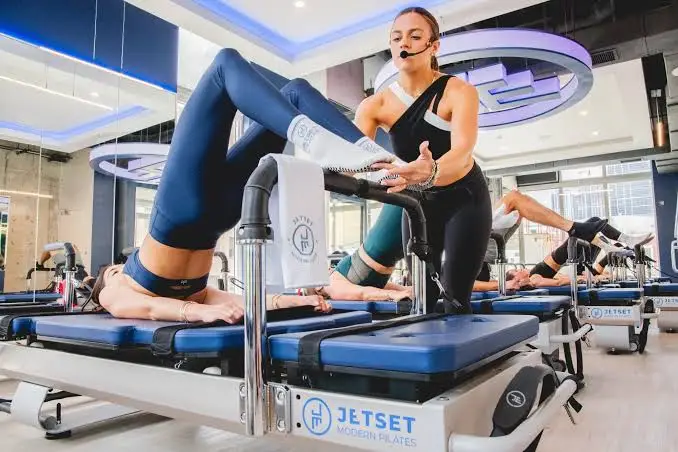
The modern Pilates market includes many formats.
You might see Jet Set Pilates and other boutique-style programs, studio reformer training, mat Pilates, home workouts, and resistance-bar programs.The important thing is to assess what each option actually offers.
Do not choose a program simply because it is popular on social media.
Look for qualified instruction, clear progression, appropriate modifications, and realistic claims.
Common Pilates Bar Workout Mistakes
Using an unstable anchor
Never attach resistance bands to something that cannot safely handle the force.
Check the manufacturer’s instructions.
Choosing excessive resistance
More resistance is not automatically better.
If you lose control, reduce it.
Neglecting the warm-up
Even a short workout deserves a brief preparation phase.
Training through pain
Muscle effort is expected.
Sharp or unusual pain is not something to ignore.
Repeating the same routine forever
Your body benefits from appropriate variation and progression.
Change exercises or resistance as your fitness develops.
Personal Insight: Why Short Workouts Can Work
One of the most useful lessons in exercise is that consistency is often more important than workout length.
A person who completes three 20-minute workouts every week may build a stronger routine than someone who plans one two-hour workout but rarely has time to complete it.
That is where a Pilates bar has a practical advantage.
It removes some of the barriers between deciding to exercise and actually starting.
You can store it easily, select a small group of exercises, and begin.
The goal is not to make every workout exhausting.
The goal is to make regular movement realistic.
Conclusion
A Pilates Bar Workout can be an efficient solution for people who want resistance training but have limited time, space, or equipment.
With a single bar and resistance bands, you can train the legs, glutes, arms, shoulders, back, and core.
Moreover, you can adjust the workout according to your schedule.
A 15-minute session can keep you moving on a busy day, while a 30- or 40-minute routine can provide a more complete workout.
However, the Pilates bar is not a replacement for every form of exercise.
Traditional resistance training may be better for maximal strength and muscle growth, while dedicated cardiovascular exercise remains important for aerobic fitness.
In short, use the Pilates bar for what it does best: providing convenient, controlled resistance that makes consistent home training easier.
The most effective workout is often the one you can realistically repeat week after week.
FAQs About Pilates Bar Workouts
Is a Pilates Bar Workout good for beginners?
Yes. Beginners can start with light resistance and basic movements such as squats, rows, curls, and bridges. Technique should come before intensity.
Can a Pilates bar help build muscle?
It can support strength and muscular endurance, especially for beginners. However, people seeking significant muscle growth may eventually need heavier progressive resistance.
How long should a Pilates Bar Workout be?
A useful session can be as short as 15 minutes, while 30–45 minutes allows more exercises and a longer warm-up and cool-down.
Can I use a Pilates bar every day?
You can use it frequently for light movement, but demanding resistance workouts require recovery. Alternate muscle groups or include rest days when needed.
Is a Pilates bar better than a reformer?
Neither is universally better. A Pilates bar is compact and affordable, while a reformer offers a broader range of carriage-based resistance exercises. Your goals and available space should guide the choice.
⭐ Make MindLiva Your Preferred Source on Google
Get trusted health, wellness, and lifestyle articles from MindLiva.
Add MindLiva
Samie Babaei is a medical science student at Shahid Beheshti University of Medical Sciences with a strong interest in health, wellness, and medical research. As a health writer and researcher at MindLiva, she focuses on creating clear, evidence-based content that helps readers better understand health and well-being.