

Pelvic Pilates: A Simple Way to Enhance Your Overall Fitness
Have you ever noticed that your lower back feels tight after sitting all day, or that your hips feel less stable during exercise?
The answer may not be to simply stretch more.
Your pelvis sits at the center of your body’s movement system. It connects your spine with your hips and legs, helping transfer force whenever you walk, run, squat, bend, or lift.
That is why Pelvic Pilates has attracted growing interest among people who want better movement control rather than another high-intensity workout.
Pilates already emphasizes breathing, alignment, controlled movement, and core stability. A pelvic-focused approach gives extra attention to pelvic position, hip control, abdominal coordination, and the muscles surrounding the pelvis.
In this guide, you will learn what Pelvic Pilates is, how it can fit into a fitness routine, which exercises beginners can try, what the research says, and when professional guidance is important.
What Is Pelvic Pilates?
Pelvic Pilates is not necessarily a separate form of Pilates.
Instead, it is a way of applying Pilates principles with particular attention to the pelvis, pelvic-floor muscles, hips, lower abdomen, breathing, and trunk stability.
The pelvis is not a single isolated structure.
It works with the spine, hips, abdominal muscles, glutes, diaphragm, and pelvic floor to help control movement.
For example, when you perform a squat, your pelvis must move and stabilize as your hips, knees, and ankles bend.
When you walk, the pelvis shifts subtly from one side to the other.
When you lift a heavy object, the muscles around your trunk and pelvis help keep your body stable while your arms and legs generate force.
Therefore, pelvic control is relevant to almost every movement.
Why Pelvic Control Matters
A stable pelvis does not mean keeping it completely still.
That is a common misunderstanding.
Your pelvis needs to move when appropriate and stabilize when necessary.
For example, during a walking stride, the pelvis naturally rotates and shifts.
During a controlled leg-lowering exercise, however, you may need to limit unwanted pelvic movement.
Good movement requires knowing the difference.
That is one reason Pilates can be useful: exercises are often slow enough to help you notice these changes.
Pelvic Pilates and Core Stability
People often think the core begins and ends with the abdominal muscles.
It does not.
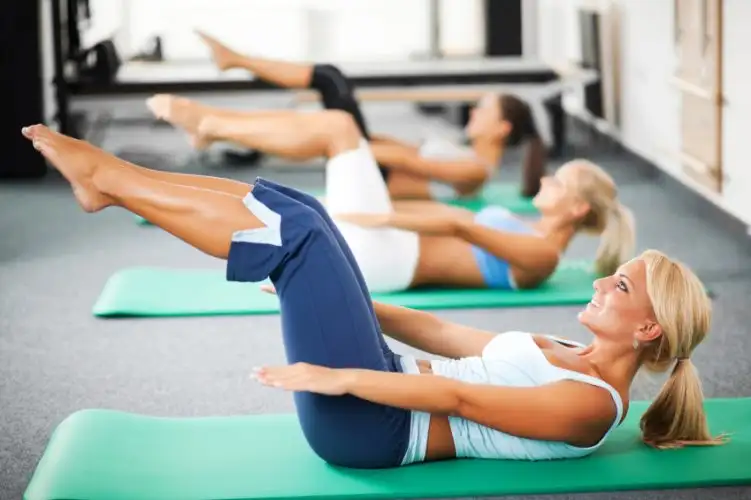
Core stability involves a group of muscles that work together to control the trunk and pelvis.
These include the abdominal wall, back muscles, diaphragm, pelvic floor, and muscles around the hips.
Think of the core as a pressure and stability system, rather than a six-pack.
When you perform a dead bug, for example, your abdominal muscles help prevent excessive movement of the spine while your arms and legs move.
When you perform a bridge, your glutes and hamstrings contribute to hip movement while your trunk and pelvis need to remain controlled.
That coordination is central to pelvic-focused Pilates.
A Strong Core Is More Than Appearance
Visible abdominal muscles are influenced heavily by body-fat levels and genetics.
Core strength is different.
You can have excellent trunk stability without visible six-pack abs.
Moreover, strong core control can help you perform everyday movements more efficiently.
Carrying groceries, climbing stairs, lifting a suitcase, or getting up from a chair all involve the trunk and pelvis.
In short, functional core strength matters far beyond aesthetics.
The Pelvic Floor: An Important Part of the System
The pelvic floor is a group of muscles located at the base of the pelvis.
These muscles contribute to support and function in the pelvic region.
They also work with breathing and abdominal pressure.
However, pelvic-floor training is often presented online in overly simple terms.
For example, telling everyone to constantly “tighten” or “hold” the pelvic floor is not necessarily appropriate.
Some people may need strengthening.
Others may have excessive pelvic-floor tension and may need to learn relaxation and coordination instead.
That is why pelvic health is individual.
If you have symptoms such as pelvic pain, urinary leakage, difficulty emptying the bladder or bowel, or other persistent concerns, it is sensible to consult a qualified healthcare professional or pelvic-health physiotherapist.
Pelvic Pilates should not be treated as a universal medical treatment.
How Pelvic Pilates May Support Better Posture
Posture is more dynamic than many people realize.
You do not have one perfect posture that you should maintain all day.
Instead, your body needs the ability to move comfortably between different positions.
Pilates can help improve awareness of pelvic alignment and spinal position.
For example, someone who spends eight hours sitting may become accustomed to a particular hip and spinal position.
A Pilates exercise that involves controlled pelvic movement can help that person explore different positions.
The goal is not to force the pelvis into one “correct” position.
The goal is better control and more movement options.
Why Sitting Can Affect Movement
Long periods of sitting do not automatically cause injury.
However, prolonged sitting often means less movement.
You may spend hours with your hips bent, your spine in a relatively fixed position, and your shoulders forward.
Breaking up sitting with walking and simple movement can therefore be valuable.
Pelvic Pilates can become one part of that strategy.
Best Pelvic Pilates Exercises for Beginners
You do not need advanced equipment to begin.
A mat and a comfortable space are enough for many basic exercises.
1. Pelvic Tilts
Lie on your back with your knees bent and your feet flat.
Gently tilt your pelvis so your lower back moves closer to the floor.
Then return to a neutral position.
Move slowly and avoid forcing the movement.
The goal is to learn how your pelvis moves.
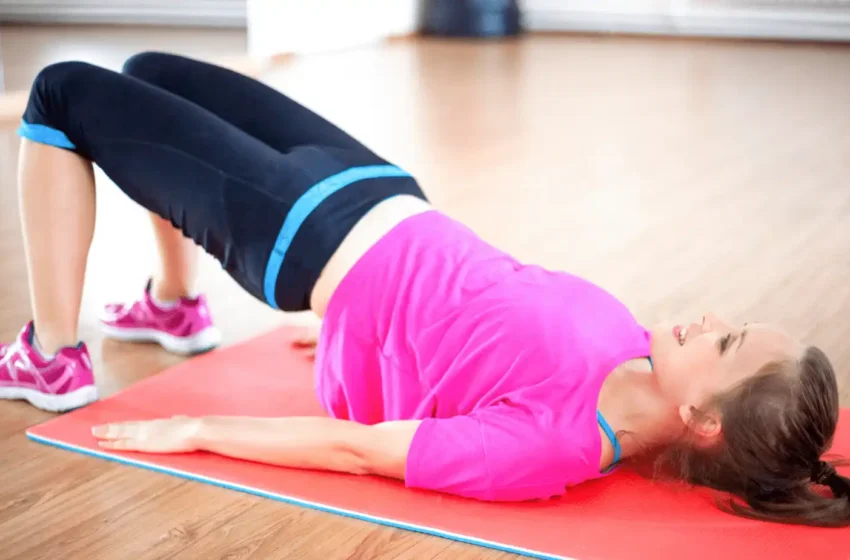
2. Glute Bridge
Lie on your back with your knees bent.
Press through your feet and slowly lift your hips.
Pause briefly at the top, then lower your spine with control.
This exercise works the glutes and hamstrings while requiring pelvic stability.
3. Dead Bug
Lie on your back with your knees bent at roughly 90 degrees.
Slowly extend one leg while maintaining control of your trunk.
Return to the starting position and switch sides.
If your lower back arches significantly, make the movement smaller.
4. Heel Slides
Lie on your back with your knees bent.
Slowly slide one heel away from your body.
Return it to the starting position and switch sides.
This is a simple way to practice pelvic control without a large range of motion.
5. Bird Dog
Start on your hands and knees.
Slowly extend one arm and the opposite leg.
Try to keep your pelvis from rotating.
Return and alternate sides.
This exercise connects trunk stability with movement of the limbs.
6. Side-Lying Leg Lift
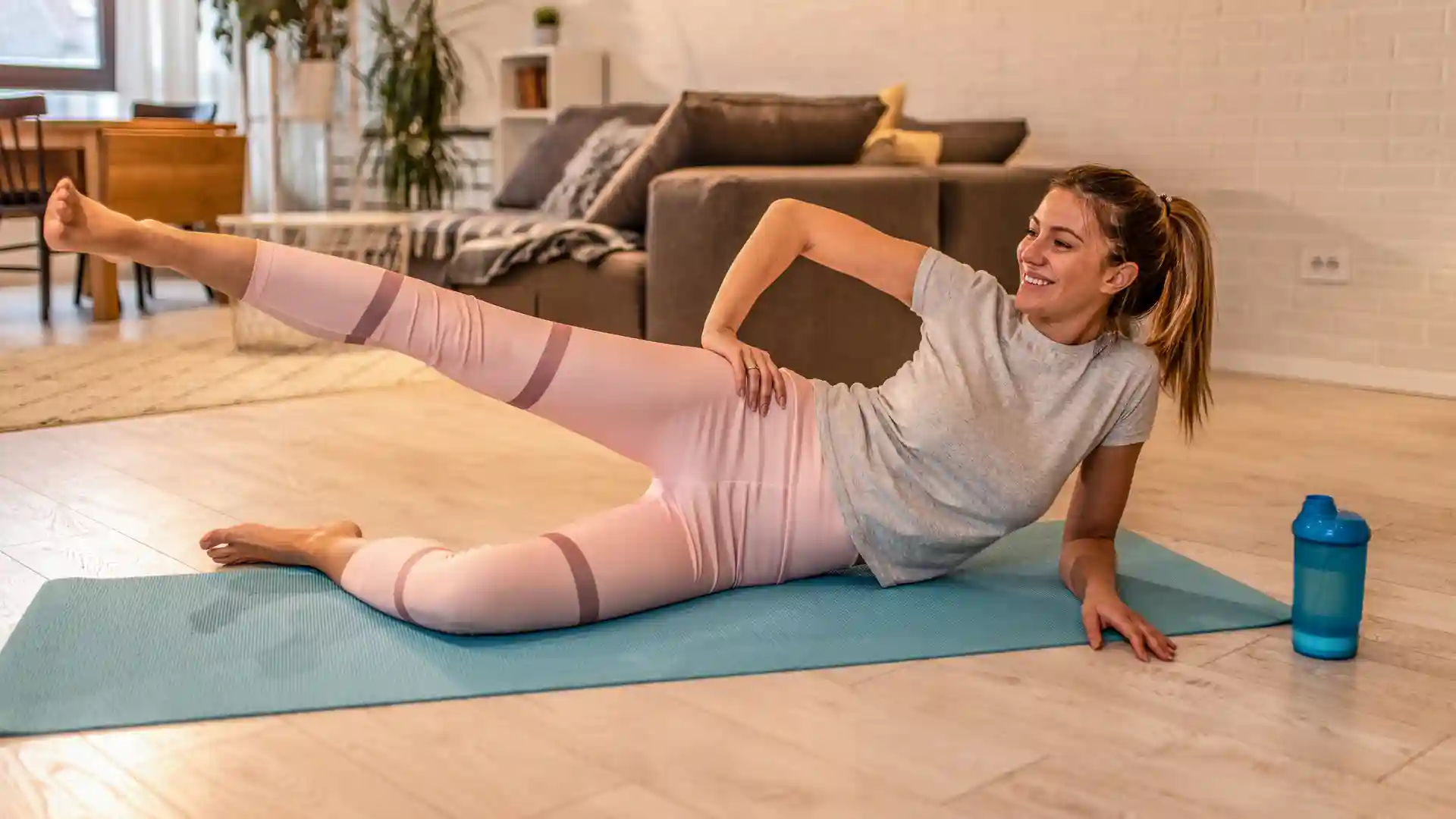
Lie on your side with your legs extended.
Lift the upper leg slowly and lower it with control.
Keep your pelvis stable rather than rolling backward.
This exercise challenges the muscles around the hip.
A Simple 15-Minute Pelvic Pilates Routine
If you are new to Pilates, start with a short routine.
Try this sequence:
- 2 minutes: relaxed breathing.
- 2 minutes: pelvic tilts.
- 3 minutes: glute bridges.
- 3 minutes: heel slides or dead bugs.
- 2 minutes: bird dogs.
- 2 minutes: side-lying leg lifts.
- 1 minute: relaxed breathing.
The session should feel controlled rather than rushed.
You should be able to breathe normally.
If an exercise causes sharp pain, stop and choose an easier variation.
Pelvic Pilates for Mobility
Mobility is not simply about being flexible.
It means having enough range of motion and the ability to control it.
The hips and pelvis are particularly important because they connect the lower body with the spine.
Good hip mobility can make everyday movements easier.
For example, getting into a car, climbing stairs, squatting down, or turning while walking all require coordinated movement around the hips and pelvis.
Pilates exercises can provide controlled practice in these positions.
However, mobility work should not be forced.
A larger range is not automatically better.
The best range is one you can control comfortably.
Pelvic Pilates for Balance and Coordination
Balance depends on several systems working together.
Your eyes provide information.
Your inner ear helps with orientation.
Your nervous system processes sensory information.
Your muscles and joints provide feedback about body position.
Pilates can challenge balance by reducing support or asking you to move one limb while stabilizing another.
For example, a single-leg exercise can reveal whether your pelvis remains level when one foot leaves the ground.
That information can be valuable.
You may discover that one side feels stronger or more stable than the other.
Instead of ignoring the difference, you can use it to guide your training.
Pelvic Pilates for Athletes
Athletes often need more than raw strength.
They need control, coordination, mobility, and the ability to transfer force.
A soccer player, for example, repeatedly changes direction.
A runner transfers force through one leg at a time.
A golfer rotates through the trunk and hips.
A tennis player needs to stabilize the lower body while producing powerful upper-body rotation.
Pelvic control can contribute to all these movements.
However, Pelvic Pilates should complement sport-specific training rather than replace it.
A football player still needs sprint training.
A weightlifter still needs progressive resistance.
A runner still needs running.
Pilates simply adds another training layer.
Pelvic Pilates for Men
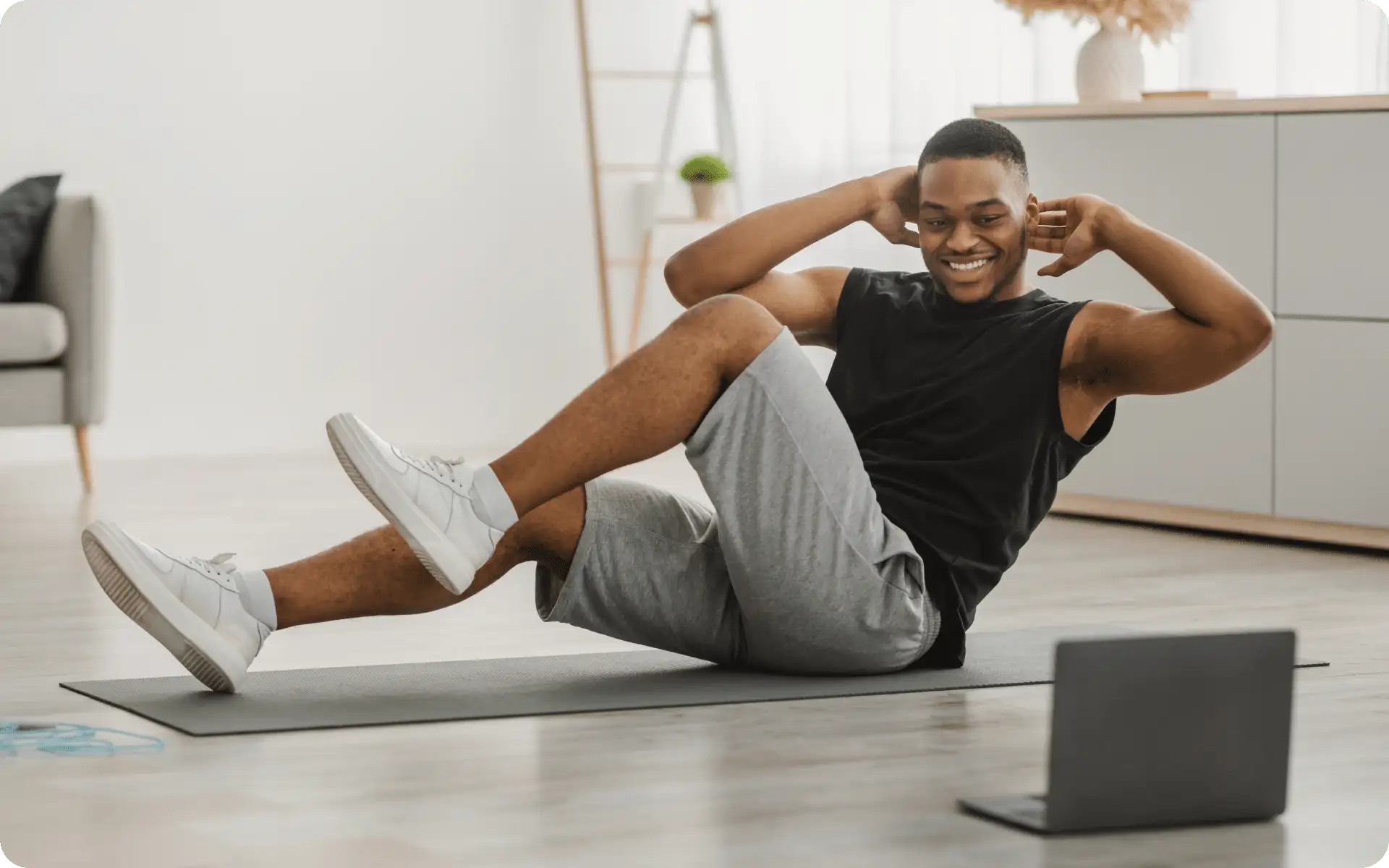
The pelvic region is important for everyone.
Pilates for Men can provide useful training for men who want better core control, hip stability, mobility, and body awareness.
Men who regularly lift weights may especially appreciate pelvic-focused exercises because heavy training can create a strong emphasis on force production.
Pilates introduces more controlled movement.
For example, a man who performs heavy squats and deadlifts might add one Pilates session each week to work on trunk control and mobility.
That does not make his strength training less effective.
It can make the overall program more balanced.
Pelvic Pilates and Women’s Fitness
Pelvic-focused Pilates is also commonly associated with women’s health, particularly around pregnancy and the postpartum period.
However, pregnancy and postpartum exercise should be individualized.
A person’s symptoms, delivery history, fitness level, and medical circumstances can all affect what exercises are appropriate.
A qualified prenatal or pelvic-health professional can provide more specific guidance.
This is especially important if someone experiences pelvic pressure, pain, urinary leakage, or other symptoms.
More exercise is not always the answer. The right exercise is the answer.
Pelvic Pilates vs. Traditional Strength Training
The Pilates Body vs Gym Body discussion applies here too.
Pilates emphasizes controlled movement, muscular endurance, stability, mobility, and body awareness.
Strength training emphasizes progressive resistance, muscle development, and maximal force production.
Neither method has to replace the other.
A balanced program might include:
| Goal | Pelvic Pilates | Strength Training |
| Core control | Excellent | Excellent |
| Hip stability | Strong focus | Strong |
| Muscle size | Moderate | Excellent |
| Maximal strength | Limited | Excellent |
| Mobility | Strong focus | Variable |
| Balance | Strong | Variable |
| Movement awareness | Strong | Exercise dependent |
If your goal is muscle growth, keep resistance training.
If your goal is better pelvic control and movement awareness, Pelvic Pilates can be useful.
If you want both, combine them.
Pelvic Pilates and the Modern Pilates Trend
The Pilates world has expanded beyond traditional studio classes.
You may encounter modern concepts such as Be Fit Modern Pilates and Jetset Pilates, alongside home-based workouts and specialized programs.
You may also see Somatic Pilates, which places additional emphasis on body awareness and internal sensation.
And searches such as 28 Day Wall Pilates Challenge Free show how popular short home programs have become.
These trends can make exercise accessible.
However, popularity does not guarantee quality.
Before following a program, consider:
- Who created it?
- Are exercises demonstrated clearly?
- Are beginner modifications provided?
- Does the program progress gradually?
- Does it make realistic claims?
- Does it encourage rest and recovery?
A good program should make you feel more capable, not pressured to perform impossible movements.
Pilates Habitat and Pelvic-Focused Training
The concept of Pilates Habitat fits naturally with pelvic-focused training because both can emphasize creating an environment where movement quality matters.
Your environment affects consistency.
A quiet space, a good mat, enough room to move, and a predictable schedule can make home exercise easier to maintain.
You do not need a luxury studio.
You need a place where you can focus.
Even 15–20 minutes can be useful when practiced consistently.
Can Pelvic Pilates Transform Your Body?
A Pilates Body Transformation should be understood realistically.
Pilates can contribute to stronger muscles, improved endurance, better balance, increased mobility, and improved movement control.
But body composition depends on many factors.
Nutrition, total activity, resistance training, sleep, genetics, and energy balance all matter.
Therefore, do not judge progress only by your appearance.
Track improvements such as:
- Better balance
- Improved exercise control
- Greater mobility
- Stronger glutes
- Better core endurance
- Less movement compensation
- More consistent exercise
These are meaningful signs of progress.
Common Pelvic Pilates Mistakes
Even simple exercises can become ineffective when technique is poor.
Mistake 1: Constantly Tucking the Pelvis
A neutral pelvis is not the same as aggressively flattening your lower back.
Your pelvis needs to move naturally.
Mistake 2: Holding Your Breath
Breathing is part of movement.
Avoid turning every core exercise into a breath-holding contest.
Mistake 3: Overusing the Abdominals
More abdominal tension is not always better.
Your core should coordinate with your hips, back, diaphragm, and pelvic floor.
Mistake 4: Moving Too Fast
Fast repetitions can hide poor pelvic control.
Slow down until you can feel what is happening.
Mistake 5: Ignoring Symptoms
Exercise should challenge you, but persistent pain or unusual symptoms deserve professional attention.
How Often Should You Do Pelvic Pilates?
There is no single perfect schedule.
For general fitness, two or three sessions per week can be a practical starting point.
A beginner could perform 20–30 minute sessions and gradually increase duration or difficulty.
If you also perform strength training, running, cycling, or other activities, consider your total workload.
For example:
Monday: Strength training
Tuesday: Pelvic Pilates
Wednesday: Walking or rest
Thursday: Strength training
Friday: Rest
Saturday: Pelvic Pilates
Sunday: Light activity
The exact schedule matters less than consistency.
Research on Pilates has commonly studied programs performed several times per week and has found benefits for outcomes such as abdominal endurance, flexibility, and balance, although evidence quality varies.
What Does the Research Say?
This is where an expert approach requires some caution.
There is evidence supporting Pilates for several physical outcomes.
A systematic review and meta-analysis found improvements in abdominal muscular endurance among healthy participants who practiced Pilates compared with inactive controls.
Other reviews have reported improvements in flexibility and dynamic balance.
However, evidence does not establish Pelvic Pilates as a cure for specific pelvic-health conditions.
Nor does it show that Pilates is always better than resistance training, yoga, or other forms of exercise.
That distinction is essential.
A useful exercise does not need to be the only exercise.
Pelvic Pilates can occupy a valuable place within a broader fitness and health strategy.
When Should You See a Professional?
There are situations where professional guidance is more appropriate than an online routine.
Consider speaking with a healthcare professional or pelvic-health physiotherapist if you experience:
- Persistent pelvic pain
- Pelvic pressure or heaviness
- Urinary leakage
- Difficulty controlling bowel or bladder function
- Pain during sexual activity
- Symptoms after childbirth or surgery
- Unexplained pain during exercise
A trained professional can assess the underlying issue and determine whether strengthening, relaxation, mobility work, breathing exercises, or another approach is appropriate.
This is particularly important because the pelvic floor can be both weak and overly tense, and those problems require different strategies.
Final Thoughts: Is Pelvic Pilates Worth Trying?
Pelvic Pilates is not a magic solution, but it can be a smart addition to a balanced fitness routine.
Its greatest value may be its focus on control.
You learn how the pelvis moves.
You learn how the hips and spine interact.
You learn how breathing and trunk stability work together.
You become more aware of small movement differences.
Moreover, those skills can support everything from everyday movement to athletic training.
If you are a beginner, start with simple exercises.
If you lift weights, use Pilates as complementary training.
If you have pelvic symptoms, get individualized professional guidance.
And if your goal is a stronger, more capable body, remember that consistency matters more than chasing the latest fitness trend.
Train for function first. Appearance can follow.
FAQs About Pelvic Pilates
What is Pelvic Pilates?
Pelvic Pilates is a Pilates-based approach that places extra attention on pelvic control, core stability, hip movement, breathing, and coordination of the muscles around the pelvis.
Is Pelvic Pilates good for beginners?
Yes. Beginners can start with gentle exercises such as pelvic tilts, bridges, heel slides, and bird dogs. The key is to focus on control rather than performing advanced movements immediately.
Can Pelvic Pilates strengthen the pelvic floor?
It can include exercises that engage and coordinate the pelvic-floor muscles. However, pelvic-floor needs vary, so people with symptoms should seek individualized assessment rather than assuming strengthening is always appropriate.
Can men do Pelvic Pilates?
Absolutely. Pelvic Pilates can be useful for men who want better core control, hip stability, mobility, and movement awareness. It can also complement strength training.
How often should I do Pelvic Pilates?
Two to three sessions per week is a practical starting point for many people. Sessions can be 15–40 minutes, depending on your experience and the rest of your exercise routine.
⭐ Make MindLiva Your Preferred Source on Google
Get trusted health, wellness, and lifestyle articles from MindLiva.
Add MindLiva
Samie Babaei is a medical science student at Shahid Beheshti University of Medical Sciences with a strong interest in health, wellness, and medical research. As a health writer and researcher at MindLiva, she focuses on creating clear, evidence-based content that helps readers better understand health and well-being.