



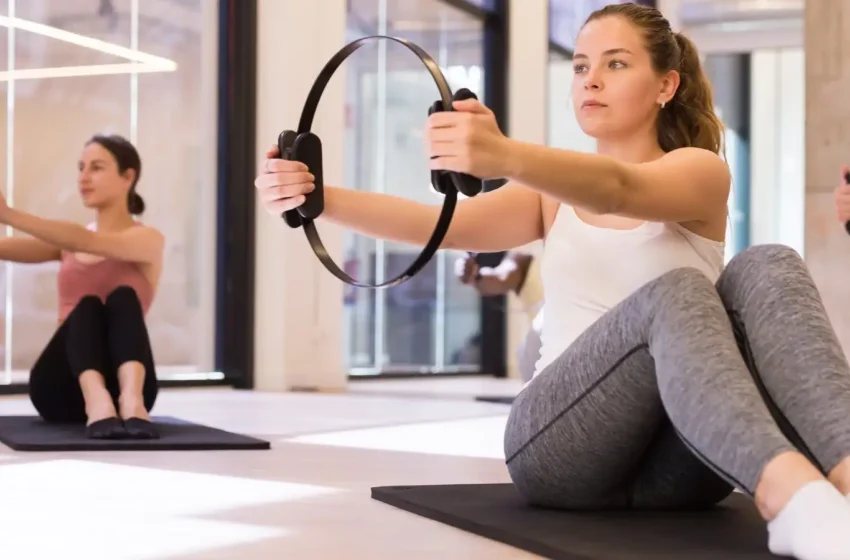
Transform Your Workout with These Pilates Ring Exercises
Have you ever finished a Pilates workout and thought, “I wish I had a simple way to make this exercise harder”?
That is where Pilates Ring Exercises can make a real difference.
Also called a Pilates circle or magic circle, the Pilates ring is a lightweight piece of equipment that adds resistance without requiring a large machine or heavy dumbbells. You can use it to challenge your inner thighs, glutes, arms, chest, and core while keeping the controlled movement that makes Pilates unique.
The ring is especially useful at home because it takes up very little space and can be added to both beginner and advanced workouts.
In this guide, you will learn how Pilates ring exercises work, which movements are most effective, how to use the ring correctly, and how to combine it with other forms of Pilates and strength training.
What Are Pilates Ring Exercises?
Pilates Ring Exercises use a flexible circular resistance tool to increase the challenge of traditional Pilates movements.
The ring is usually made from a flexible material with padded handles on opposite sides. Depending on the exercise, you can place it between your thighs, above your knees, between your hands, or against another part of your body.
The resistance comes from squeezing or controlling the ring.
That sounds simple, but the small amount of resistance can create a significant change in muscle engagement.
For example, placing the ring between your thighs during a bridge encourages you to actively press inward while lifting your hips.
The result is a movement that challenges the glutes while also asking the inner thighs and core to stabilize the body.
Why the Pilates ring is so useful
The ring has three major advantages:
- It is compact.
- It is relatively inexpensive compared with large Pilates equipment.
- It can make familiar exercises more challenging.
Moreover, you do not need to squeeze the ring as hard as possible.
Controlled resistance is more important than maximum force.
How Pilates Ring Exercises Build Strength
Pilates is often associated with flexibility and gentle movement, but resistance is an important part of the method.
The ring provides external resistance that can increase muscular demand.
However, it works differently from heavy barbell training.
A ring is not designed primarily to help you lift maximum weight. Instead, it encourages muscular endurance, control, stability, and body awareness.
That makes it particularly useful for people who want to make Pilates more challenging without turning every workout into a heavy strength session.
The role of muscular endurance
Imagine holding the ring between your thighs while completing a series of controlled leg movements.
Your muscles have to maintain pressure for an extended period.
That can create fatigue even though the resistance is relatively light.
This is one reason Pilates ring training can feel harder than it looks.
The Best Pilates Ring Exercises for Beginners
You do not need dozens of movements to get started.
A few foundational exercises can train several major muscle groups.
1. Inner-Thigh Ring Squeeze
This is one of the simplest ways to learn how the ring works.
Sit or lie comfortably and place the ring between your thighs.
Gently squeeze the ring, hold for a moment, and slowly release.
Try:
- 10–15 controlled repetitions
- A short pause during each squeeze
- Relaxed breathing throughout
The key is to avoid squeezing as hard as possible.
Instead, use enough pressure to feel the muscles working while maintaining good posture.
2. Glute Bridge With the Ring
Lie on your back with your knees bent and place the ring between your thighs.
Gently press inward as you lift your hips.
At the top, pause briefly before lowering with control.
This variation combines glute activation, inner-thigh engagement, and core stability.
It is a useful beginner exercise because the basic bridge is already familiar to many people.
3. Ring-Assisted Squat
Place the ring between your thighs or above the knees, depending on the ring design and your comfort.
Perform a controlled squat while maintaining stable knee alignment.
The ring provides a cue to keep the legs engaged.
However, avoid allowing your knees to collapse inward.
Your movement should remain controlled from start to finish.
Pilates Ring Exercises for the Core
The Pilates ring can also make abdominal training more demanding.
The important point is that core training should involve more than simply creating a burning sensation in your stomach.
The core helps stabilize the pelvis and spine while your limbs move.
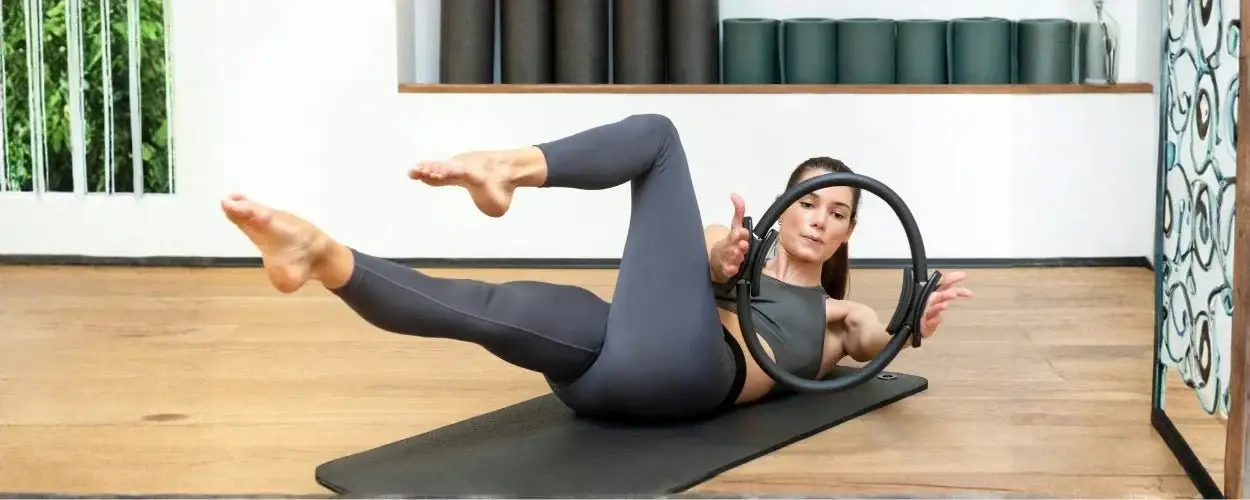
Ring Toe Tap
Lie on your back with your legs raised into a comfortable tabletop position.
Hold the ring between your hands and gently press inward.
Slowly lower one foot toward the floor, then return to the starting position.
Alternate sides.
This exercise combines upper-body resistance with lower-body movement while asking the trunk to remain stable.
Ring Dead Bug Variation
The dead bug is already a useful core exercise.
Adding a ring between your hands can create additional upper-body tension.
Move slowly and keep your lower back controlled.
If your back begins to arch excessively, reduce the movement range.
Good technique is more valuable than completing more repetitions.
Pilates Ring Exercises for the Arms and Chest
The ring is not only a lower-body tool.
You can hold it between your hands to challenge the chest, shoulders, and arms.
Chest Press
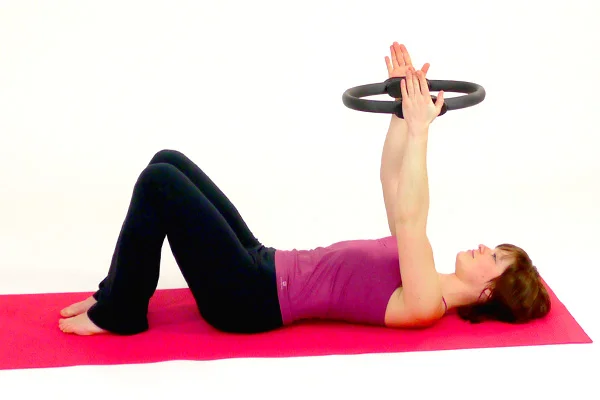
Hold the ring at chest height with both hands.
Gently press inward while keeping your shoulders relaxed.
Hold briefly, then slowly release the pressure.
The movement looks small, but maintaining controlled pressure can challenge the chest and shoulder muscles.
Overhead Ring Press
Hold the ring above your head with both hands.
Press inward while maintaining a neutral posture.
Avoid shrugging your shoulders toward your ears.
If your shoulders feel uncomfortable, lower the ring and reduce the range of motion.
Why small movements can work
One of the most common misconceptions about Pilates is that an exercise must involve a large movement to be effective.
That is not always true.
The ring can create isometric tension, meaning muscles work while the joint position changes very little.
This makes small movements surprisingly demanding.
Pilates Ring Exercises for the Glutes and Legs
If your goal is to strengthen your lower body, the ring can be useful alongside traditional Pilates exercises.
Side-Lying Ring Press
Lie on your side and place the ring between your legs.
Gently press against the ring while maintaining a stable pelvis.
The movement should be slow and controlled.
This can challenge the inner and outer hip muscles depending on the position and direction of pressure.
Bridge With Ring Resistance
The bridge variation can also be progressed.
Start with both feet on the floor.
As you become stronger, you can experiment with longer holds or additional repetitions rather than immediately choosing a more complex movement.
Clamshell With a Ring
A ring can be placed above or between the knees depending on the exercise setup.
Perform a controlled hip-opening movement while keeping the pelvis stable.
This can challenge the gluteal muscles and hip stabilizers.
If you feel the movement mostly in your lower back, reduce the range and focus on keeping the pelvis steady.
Pilates Ring Exercises for Posture and Stability
Good posture is not simply about sitting up straight.
It involves how your body controls movement and maintains alignment.
Ring exercises can provide resistance that encourages awareness of the shoulders, spine, pelvis, and hips.
For example, holding the ring between your hands during an upper-body exercise can remind you to keep your shoulders controlled rather than letting them move randomly.
Similarly, lower-body ring work can help you become more aware of knee and hip alignment.
However, Pilates should not be presented as a cure for every posture or pain problem.
Persistent pain deserves appropriate professional assessment.
How to Use a Pilates Ring Correctly
The equipment is simple, but technique still matters.
Follow these basic principles:
- Start with gentle pressure.
- Keep movements slow.
- Avoid holding your breath.
- Maintain comfortable joint positions.
- Stop if you experience sharp pain.
- Focus on alignment before increasing repetitions.
- Progress gradually.
One of the biggest mistakes is trying to crush the ring.
You do not need maximum pressure.
Instead, think about creating steady resistance while maintaining control.
Common Pilates Ring Mistakes
Mistake 1: Using too much force
If you squeeze the ring aggressively, you may create unnecessary tension in your neck and shoulders.
Use moderate pressure.
Mistake 2: Holding your breath
People often unconsciously hold their breath when an exercise becomes difficult.
Try to maintain steady breathing.
Mistake 3: Moving too quickly
Speed can hide poor control.
Slow down and focus on the muscles involved.
Mistake 4: Ignoring alignment
A ring cannot fix poor technique.
Keep your knees, hips, shoulders, and spine in a comfortable position appropriate to the exercise.
Mistake 5: Doing too many repetitions
More repetitions are not automatically better.
If your technique deteriorates, stop the set.
Pilates Ring Exercises vs. Reformer Pilates
A Pilates ring and reformer provide different forms of resistance.
A reformer uses springs, a moving carriage, straps, and a footbar.
A ring relies primarily on manual pressure.
Pilates Reformers can offer more resistance options and a wider range of exercises, while a ring is inexpensive, portable, and easy to use almost anywhere.
For example, an advanced user might complete reformer training at a studio and then use a Pilates ring for a short home workout.
The two tools can complement each other.
Using a Ring With an Aero Pilates Reformer
The Aero Pilates Reformer provides a larger equipment system with spring resistance and, depending on the model, a rebounder.
A Pilates ring can be used alongside some reformer exercises, provided the movement is appropriate and the equipment setup is safe.
For example, an instructor might use the ring to add inner-thigh or upper-body resistance to a controlled sequence.
However, avoid improvising complicated combinations without instruction.
When multiple pieces of equipment are involved, the risk of losing control can increase.
Pilates Ring Exercises and the Pilates Reformer Workout
A Pilates Reformer Workout can provide resistance through the springs and carriage.
The ring can add another layer of resistance or help reinforce body awareness.
This combination can be useful for experienced users who understand how both pieces of equipment work.
Beginners should generally master the basic reformer and ring movements separately before combining them.
That makes it easier to focus on technique.
What About Portable Pilates Equipment?
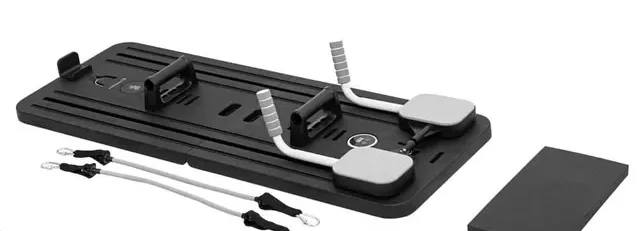
One reason people enjoy the Pilates ring is its convenience.
Compared with a Portable Pilates Reformer, a ring takes almost no storage space.
You can place it in a drawer, take it on a trip, or keep it beside your exercise mat.
This makes it a practical tool for people who want resistance training without dedicating an entire room to fitness equipment.
The limitation is that the ring cannot reproduce every reformer movement.
It is a supplement, not a replacement for every type of Pilates equipment.
Pilates Ring Exercises for Different Fitness Levels
The ring can be adapted to different abilities.
Beginners
Start with simple exercises such as:
- Inner-thigh squeezes
- Chest presses
- Basic bridges
- Gentle side-lying movements
Focus on learning control.
Intermediate users
Add longer holds, more repetitions, and more complex combinations.
You might use the ring during core sequences or single-leg movements.
Advanced users
Experienced practitioners can combine the ring with challenging Pilates positions.
However, difficulty should never come at the expense of control.
A complicated movement performed poorly is not better than a basic movement performed well.
How Many Pilates Ring Exercises Should You Do?
You do not need an extremely long workout.
A practical beginner session might take 20–30 minutes.
For example:
Warm-up: 5 minutes
Legs and glutes: 7 minutes
Core: 7 minutes
Arms and chest: 5 minutes
Cool-down: 3–5 minutes
As your fitness improves, you can increase the session length or difficulty.
The important thing is to progress gradually.
Building a Weekly Pilates Routine
A Pilates ring can fit into many different schedules.
For example:
Monday: Full-body Pilates ring session
Tuesday: Walking or cardio
Wednesday: Strength training
Thursday: Mobility or rest
Friday: Pilates ring session
Saturday: Reformer Pilates or another activity
Sunday: Recovery
This approach gives your body different types of movement.
Moreover, it prevents you from relying on one exercise method for every fitness goal.
Pilates Ring Exercises and Other Popular Pilates Trends
Today’s Pilates market includes many different approaches.
You may encounter studio-based Jet Set Pilates, online Pilates programs, reformer training, mat classes, and specialized equipment.
The name of the program matters less than the quality of instruction.
A good Pilates program should teach you how to move safely, provide modifications, and gradually increase difficulty. Look beyond marketing claims and consider whether the training method actually fits your goals.
Pilates Roll Up and the Pilates Ring
The Pilates Roll Up is a classic Pilates movement that can challenge the abdominals and spinal control.
Adding a ring can increase the complexity, but this is not necessarily appropriate for beginners.
If you cannot perform the basic roll-up with good control, learn the movement first.
Progression should be earned through technique.
That principle applies to every Pilates exercise.
How Pilates Ring Exercises Compare With Weights
A ring is not equivalent to a dumbbell or barbell.
Traditional weights are often easier to measure and progressively increase.
For example, you can move from a 10-pound dumbbell to a 12-pound dumbbell.
With a ring, progression may instead involve increased control, longer holds, more repetitions, altered body position, or a more difficult exercise.
Therefore, ring training is particularly useful for muscular endurance and movement control, while conventional weights may be more suitable for maximal strength and hypertrophy.
The two can work together.
Safety Tips for Pilates Ring Exercises
Before starting any new exercise routine, consider your current fitness level and physical condition.
If you have an injury, recent surgery, severe pain, or another medical concern, seek appropriate professional advice before exercising.
During workouts:
- Use a stable surface.
- Check the ring for damage.
- Avoid sudden movements.
- Keep breathing normally.
- Use controlled resistance.
- Stop if you experience unusual pain.
If an exercise feels wrong, do not force it simply because a video says you should complete the repetition.
Personal Insight: Why the Pilates Ring Remains Useful
One of the most practical lessons about small fitness equipment is that simplicity often improves consistency.
A large machine can provide more possibilities, but it also requires space, setup, and commitment.
A ring can sit next to your yoga mat and be ready in seconds.
That convenience matters.
If you can easily add 15 or 20 minutes of movement to your day, you may be more likely to exercise consistently.
In fitness, that matters far more than owning the most impressive equipment.
Conclusion
Pilates Ring Exercises are a simple way to add resistance, variety, and greater muscle engagement to a Pilates routine.
The ring can challenge the inner thighs, glutes, arms, chest, and core without requiring large or expensive equipment.
More importantly, it can be adapted to different fitness levels.
Beginners can start with basic squeezes and bridges. Intermediate users can add longer holds and more complex movements. Advanced practitioners can combine the ring with challenging Pilates sequences.
However, the goal should always be controlled progression, not maximum difficulty.
The ring is also easy to store, inexpensive compared with many larger fitness machines, and convenient enough for regular home use.
In short, you do not need complicated equipment to make Pilates more effective. Sometimes, a small ring and good technique are enough to create a meaningful training challenge.
FAQs About Pilates Ring Exercises
What are Pilates Ring Exercises good for?
They can strengthen and challenge the inner thighs, glutes, arms, chest, and core while improving muscular endurance, stability, and body awareness.
Can beginners use a Pilates ring?
Yes. Beginners can start with simple movements such as inner-thigh squeezes, chest presses, and bridges before progressing to more demanding exercises.
How often should I do Pilates Ring Exercises?
Two or three sessions per week can be a practical starting point. Allow your body enough recovery time, especially if you also perform strength training.
Can a Pilates ring help tone your body?
It can strengthen muscles and improve muscular endurance, which may contribute to a more defined appearance. However, visible body composition changes also depend on nutrition and overall activity.
Is a Pilates ring better than a reformer?
Neither is universally better. A ring is affordable, portable, and simple, while a reformer offers adjustable spring resistance and a much wider range of movement options.
⭐ Make MindLiva Your Preferred Source on Google
Get trusted health, wellness, and lifestyle articles from MindLiva.
Add MindLiva
Samie Babaei is a medical science student at Shahid Beheshti University of Medical Sciences with a strong interest in health, wellness, and medical research. As a health writer and researcher at MindLiva, she focuses on creating clear, evidence-based content that helps readers better understand health and well-being.