

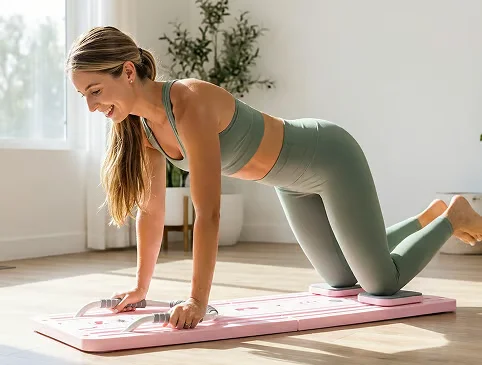
Portable Pilates Reformer: Train Anywhere, Anytime
Have you ever wanted to try reformer Pilates but looked at the size of the equipment and thought, “Where would I even put that?”
That is one reason the Portable Pilates Reformer has become an appealing option for home fitness. Traditional reformer machines can be large and difficult to move, while portable designs aim to offer a more practical solution for people with limited space.
However, compact equipment is not automatically better. A smaller reformer may involve trade-offs in carriage length, stability, resistance, or exercise range.
So, what should you actually look for?
In this guide, we will explore how portable reformers work, their main benefits and limitations, who can use them, how to structure a workout, and what to check before buying one. We will also compare portable equipment with studio training and other home Pilates options.
What Is a Portable Pilates Reformer?
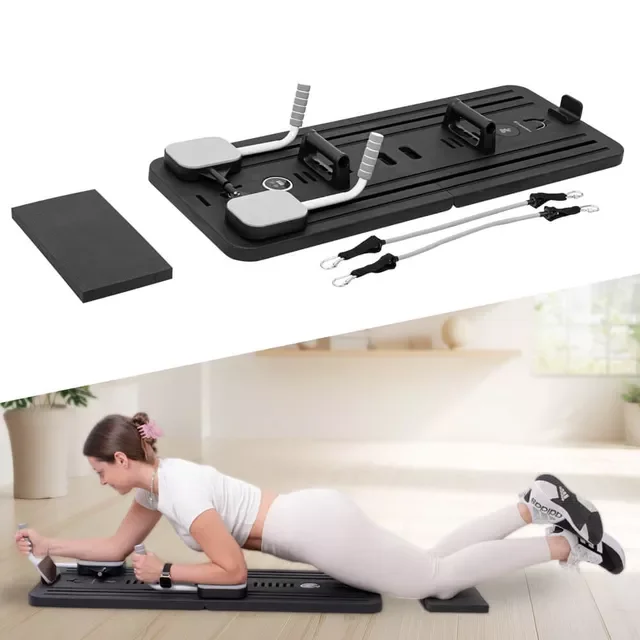
A Portable Pilates Reformer is a compact reformer-style exercise machine designed to be easier to move, store, or transport than a full-size studio reformer.
The basic concept remains similar.
A reformer generally uses a moving carriage, resistance springs or bands, a footbar, straps, and supports to create controlled resistance during exercise.
The difference is that portable models are designed with convenience in mind.
Some are foldable. Others are lightweight or relatively narrow. Certain models may use simplified resistance systems to reduce size and weight.
This makes them attractive for:
- Small apartments
- Home gyms
- Bedrooms or spare rooms
- Travelers
- People who need easy storage
- Beginners who want home-based Pilates
However, portable does not mean identical to studio equipment.
That distinction is important when comparing different models.
Why Portable Pilates Reformer Equipment Is Becoming Popular
Home fitness has changed the way people think about exercise.
Instead of driving to a gym or attending a class at a fixed time, many people now want equipment that fits around their schedules.
A portable reformer can support that lifestyle.
For example, imagine someone who works from home and has only a small amount of free floor space. A large studio-style reformer may not be practical.
A compact machine that can be stored after a workout may be much easier to live with.
Convenience can improve consistency
This is one of the strongest arguments for home equipment.
If your reformer is already available, you can start exercising without commuting.
That can remove several small barriers:
- Finding a parking space
- Traveling to a studio
- Waiting for equipment
- Working around class times
- Traveling home afterward
Those minutes can add up.
Moreover, the easier an activity is to start, the more realistic it may become as part of your weekly routine.
Portable Pilates Reformer Benefits
A portable reformer can provide several practical advantages.
1. Space efficiency
The biggest benefit is often storage.
A full-size reformer may require a dedicated workout area. A portable design may be easier to move against a wall, under furniture, or into a storage area, depending on the model.
Always check the actual folded dimensions before buying.
Product photographs can make equipment look smaller than it really is.
2. Home workout flexibility
You can exercise when your schedule allows.
That could mean a 20-minute session before work, a lunchtime workout, or a longer session in the evening.
3. Lower commitment to studio schedules
Pilates Reformer Classes provide instructor support and social motivation, but they also follow a fixed timetable.
Home equipment gives you more control over when you train.
4. Private training environment
Some beginners feel uncomfortable learning new movements in a busy studio.
At home, you can repeat beginner sessions and become familiar with the equipment at your own pace.
5. Easy integration into a fitness routine
A reformer does not have to be your only form of exercise.
You can combine it with walking, cycling, strength training, mobility work, or other activities.
What Muscles Does a Portable Pilates Reformer Work?
Reformer Pilates is often described as a core-focused workout, but that description is incomplete.
Depending on the exercise, reformer training can challenge the:
- Abdominals
- Glutes
- Hamstrings
- Quadriceps
- Calves
- Hip muscles
- Chest
- Shoulders
- Arms
- Back
The reformer creates resistance while requiring you to control your body position.
That combination can make relatively small movements feel demanding.
Core control is central
Many reformer exercises require the torso to remain stable while the arms or legs move.
For example, during controlled leg work, your legs may move against spring resistance while your abdominal muscles help stabilize your pelvis.
That is one reason Pilates emphasizes control rather than speed.
Portable Pilates Reformer for Beginners
You do not need to be an experienced Pilates practitioner to start.
However, beginners should avoid treating the reformer like a machine that must be mastered in one session.
Start with foundational movements.
A beginner approach
During your first few sessions, focus on:
- Learning the equipment
- Understanding resistance settings
- Finding comfortable foot positions
- Practicing basic footwork
- Learning how to control the carriage
- Maintaining steady breathing
Do not worry about performing advanced movements immediately.
Good Pilates training is progressive.
You first learn control, then gradually add complexity.
Why instructor guidance can help
A video can demonstrate an exercise, but it cannot always see what your body is doing.
An instructor can identify problems such as excessive spinal movement, poor knee alignment, or incorrect resistance.
Therefore, beginners may benefit from taking a few supervised sessions before relying entirely on home workouts.
How to Choose the Right Portable Pilates Reformer
Buying a reformer is different from buying a yoga mat.
There are several mechanical and practical factors to consider.
1. Stability
A reformer should feel secure during movement.
If the frame shifts every time you push against the footbar, the experience can become frustrating.
Stability becomes especially important during exercises that require more force or a wider range of movement.
2. Carriage length
This is an often-overlooked factor.
A very compact carriage may be less comfortable for taller users.
Before buying, check the manufacturer’s recommended user height and compare it with your own measurements.
3. Resistance
Look at the type and range of resistance.
Some machines use springs. Others may rely on bands or alternative systems.
The resistance should be appropriate for your current fitness level while offering room for progression.
4. Weight capacity
Always check the stated user weight limit.
Do not assume that two machines with similar designs have identical capacities.
5. Footbar adjustments
An adjustable footbar can make the equipment more adaptable to different users and exercises.
However, adjustment mechanisms should feel secure rather than loose.
6. Storage
Ask yourself where the reformer will actually go when you are not exercising.
Measure the available space.
Then measure the machine.
Do not rely on memory or visual estimates.
Portable Pilates Reformer vs. Full-Size Reformers
Traditional Pilates Reformers are generally designed for studio use and may provide a larger carriage, more adjustment options, and a wider range of exercises.
Portable models prioritize convenience.
Here is a simple comparison:
| Feature | Portable Reformer | Full-Size Reformer |
| Storage | Usually easier | Requires more space |
| Portability | Higher | Lower |
| Carriage size | May be smaller | Usually larger |
| Studio-style experience | Depends on model | Generally stronger |
| Home suitability | Excellent for smaller spaces | Better for dedicated rooms |
| Exercise range | Can be more limited | Usually broader |
| Weight | Usually lower | Usually higher |
Neither option is automatically superior.
The right choice depends on what matters most to you.
If space is your biggest problem, portability may be more valuable than maximum exercise range.
Portable Pilates Reformer vs. Aero Pilates Reformer
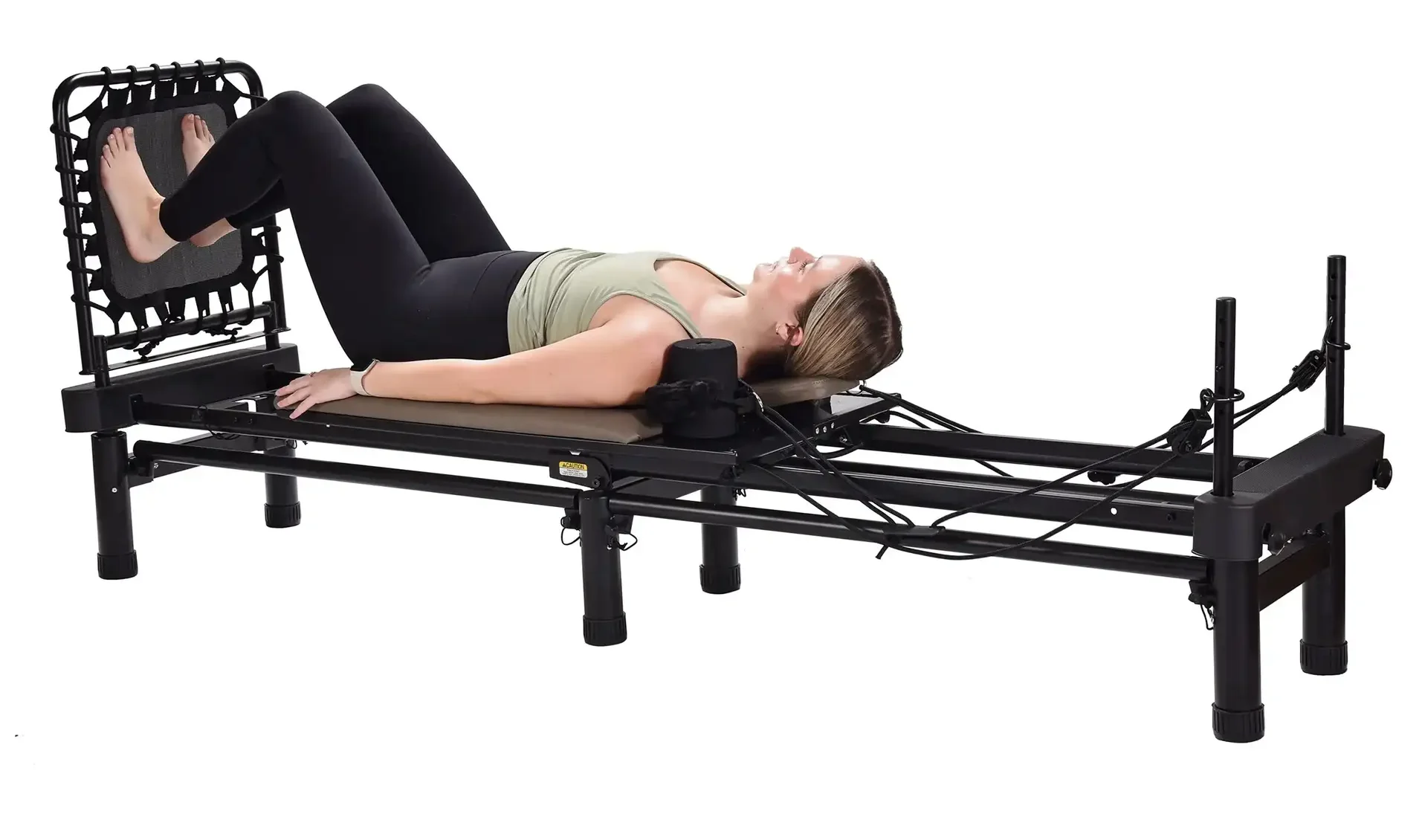
You may also encounter the Aero Pilates Reformer when researching home reformer equipment.
AeroPilates products have helped make reformer-style workouts more accessible to home users, with designs that can include features such as spring resistance and, on some models, a rebounder.
A portable reformer can overlap with this category in terms of home use.
However, do not choose equipment simply because it is marketed as compact.
Compare:
- Frame construction
- Resistance system
- Carriage size
- Maximum user weight
- Storage requirements
- Warranty
- Replacement parts
- Available workouts
The details matter more than the label.
Building a Portable Pilates Reformer Workout
A good Pilates Reformer Workout does not need to be extremely complicated.
In fact, beginners often benefit more from a small number of exercises performed with control.
A basic 30-minute session might look like this:
Warm-up — 5 minutes
Gentle mobility and breathing.
Footwork — 5 minutes
Controlled leg presses using appropriate resistance.
Glute and hamstring work — 5 minutes
Bridges or related movements.
Core training — 5 minutes
Controlled trunk stabilization exercises.
Upper-body work — 5 minutes
Arm pulls or other appropriate resistance movements.
Cool-down — 5 minutes
Gentle mobility and breathing.
The exact routine should depend on your equipment and training level.
How Often Should You Use a Portable Pilates Reformer?
There is no universal number that works for everyone.
For many people, two to four sessions per week can be a practical routine.
Beginners may start with two sessions.
As your technique and recovery improve, you can increase frequency if appropriate.
The important point is to avoid increasing everything at once.
Do not suddenly increase resistance, session length, exercise complexity, and frequency simultaneously.
Progress one variable at a time.
Portable Pilates Reformer for Weight Loss
One common reason people investigate reformer Pilates is weight management.
Pilates can contribute to overall physical activity, but it is important to maintain realistic expectations.
A reformer workout may increase energy expenditure and help build or maintain muscle, but fat loss depends on overall energy balance.
Your diet, daily movement, sleep, stress, and other forms of exercise also matter.
For example, someone might complete three Pilates sessions each week but remain sedentary for most of the day.
Another person may combine Pilates with regular walking and strength training.
Their total activity levels could be very different.
In short, Pilates can be part of a weight-management strategy, but it should not be treated as a magic solution.
Can a Portable Reformer Build Muscle?
Yes, it can contribute to muscular development, particularly in beginners and people who have not previously trained with resistance.
However, the amount of muscle growth depends on the resistance available, training volume, nutrition, recovery, and progressive overload.
Someone focused on maximum hypertrophy may eventually benefit from traditional resistance training with heavier loads.
A portable reformer is better viewed as a versatile resistance and movement-training tool.
It can develop muscular endurance, strength, balance, stability, and coordination.
Combining Reformer Pilates With Other Exercise
You do not need to choose between Pilates and other training styles.
A balanced weekly routine can include several forms of exercise.
For example:
Monday: Portable reformer
Tuesday: Walking or cycling
Wednesday: Strength training
Thursday: Rest
Friday: Portable reformer
Saturday: Cardio or recreational activity
Sunday: Mobility and recovery
This approach can provide variety.
Moreover, different forms of exercise can address different fitness qualities.
Pilates can emphasize control and stability, while traditional resistance training can provide heavier progressive loading.
Cardio can target aerobic fitness.
Together, they can create a more complete program.
Adding Pilates Ring Exercises
Small equipment can also complement reformer training.
Pilates Ring Exercises can add resistance to the inner thighs, glutes, arms, and core.
For example, you might perform reformer footwork and then use a Pilates ring for a short upper-body or inner-thigh sequence.
This can add variety without requiring another large machine.
The same principle applies to other compact tools such as resistance bands and small weights.
Portable Pilates Reformer and the Pilates Roll Up
The Pilates Roll Up is a classic mat-based Pilates exercise that focuses on abdominal control and spinal movement.
It does not require a reformer.
However, reformer training can develop some of the strength and control needed for more advanced mat exercises.
Beginners should not force a full roll-up if they cannot perform it comfortably.
A modified movement can provide a better starting point.
Portable Pilates Reformer vs. Home Mat Pilates
A mat is still one of the simplest ways to practice Pilates.
It requires little space and almost no equipment.
A portable reformer, however, adds external resistance and a moving carriage.
Mat Pilates advantages
- Very affordable
- Easy to store
- Travel-friendly
- Simple setup
- Large selection of beginner workouts
Reformer advantages
- Adjustable resistance
- More exercise variations
- Moving carriage
- Additional stability challenges
- Stronger tactile feedback
For some people, the best approach is to use both.
Mat Pilates can be convenient for travel, while reformer training can provide more resistance and variety at home.
What About Boutique Pilates?
The rise of boutique fitness has made reformer Pilates more visible.
You may see programs such as Jet Set Pilates alongside independent studios, online classes, and home equipment.
Boutique studios can provide a strong social experience and instructor support.
However, the atmosphere should not be confused with training quality.
When choosing a class, look for:
- Qualified instructors
- Clear instructions
- Beginner modifications
- Safe equipment use
- Sensible exercise progression
A fashionable studio can be enjoyable, but effective exercise still depends on sound training principles.
What Reviews Can and Cannot Tell You
Before buying a reformer, you may encounter searches such as Flo Pilates Reviews and Flo Pilates Reformer Reviews.
Reviews can be useful, but they should be interpreted carefully.
A person’s experience may depend on their height, fitness level, available space, expectations, and previous experience.
Look for detailed reviews
Useful reviews often explain:
- How long the equipment was used
- How frequently it was used
- Whether it remained stable
- How comfortable the carriage was
- Whether assembly was difficult
- How customer service responded
- Whether replacement parts were available
A short comment saying “Great machine!” provides little information.
A detailed account describing how the machine performed after six months is much more valuable.
Common Portable Pilates Reformer Mistakes
Buying without measuring
Always measure your space first.
Remember that you need room around the equipment, not just enough room for the machine itself.
Choosing the cheapest option
Price matters, but so does durability.
A low-cost reformer that becomes unusable may provide poor long-term value.
Ignoring user height
A short carriage may not be comfortable for taller users.
Check the manufacturer’s specifications.
Using excessive resistance
More resistance is not automatically better.
Control should remain the priority.
Following advanced workouts too soon
Social media often makes advanced Pilates look effortless.
Do not assume that a complicated movement is appropriate for a beginner.
Build the basics first.
Safety Tips for Portable Pilates Reformer Training
Before each workout, inspect the equipment.
Check the frame, straps, springs or bands, footbar, carriage, and other moving parts.
Make sure everything is securely positioned.
During exercise:
- Use controlled movements.
- Keep resistance appropriate.
- Maintain stable alignment.
- Avoid sudden jerking.
- Follow the manufacturer’s instructions.
- Stop if you experience sharp or unusual pain.
If you have an injury or a medical concern, seek advice from an appropriate healthcare professional before beginning a new exercise program.
Personal Insight: Portability Is Really About Consistency
One of the most useful lessons from home fitness is that convenience has real training value.
People often search for the most advanced equipment available.
However, the better question is:
“Will I actually use this?”
A sophisticated reformer that sits unused because it takes too much effort to set up is not a useful investment.
A simpler machine that you can access easily and use several times a week may provide much greater value.
That does not mean quality should be ignored.
It means quality and convenience need to work together.
Conclusion
A Portable Pilates Reformer can be an excellent option for people who want reformer-style training without dedicating an entire room to fitness equipment.
Its biggest strengths are convenience, flexibility, and space efficiency.
However, portability should never be the only buying factor.
Stability, carriage size, resistance, user height, weight capacity, comfort, warranty, and storage requirements all deserve attention.
Moreover, the best reformer is not necessarily the biggest or most expensive model.
It is the one that fits your body, space, budget, and training goals.
A portable reformer can support core strength, muscular endurance, balance, mobility, and controlled resistance training. It can also complement walking, cardio, strength training, and mat Pilates.
In short, choose equipment that makes regular exercise easier—not equipment that simply looks impressive in your home.
If the machine fits your lifestyle and you use it consistently, it can become a valuable part of a long-term fitness routine.
FAQs About Portable Pilates Reformers
Is a Portable Pilates Reformer good for beginners?
Yes. Beginners can use one, provided they start with basic movements and appropriate resistance. Professional instruction can also help with equipment setup and technique.
Is a portable reformer as good as a studio reformer?
Not necessarily. Studio reformers often provide larger carriages and more adjustment options. However, portable models can be more convenient for home users with limited space.
Can I lose weight with a Portable Pilates Reformer?
Reformer Pilates can contribute to physical activity and fitness, but weight loss depends on overall energy balance, nutrition, daily movement, and other lifestyle factors.
How often should I use a portable reformer?
Two to four sessions per week can be a practical starting range for many people. Your training frequency should match your fitness level, workout intensity, and recovery.
What should I check before buying a portable reformer?
Check stability, carriage length, resistance, weight capacity, user-height limits, dimensions, storage needs, warranty, and replacement-part availability before making a purchase.
⭐ Make MindLiva Your Preferred Source on Google
Get trusted health, wellness, and lifestyle articles from MindLiva.
Add MindLiva
Samie Babaei is a medical science student at Shahid Beheshti University of Medical Sciences with a strong interest in health, wellness, and medical research. As a health writer and researcher at MindLiva, she focuses on creating clear, evidence-based content that helps readers better understand health and well-being.