



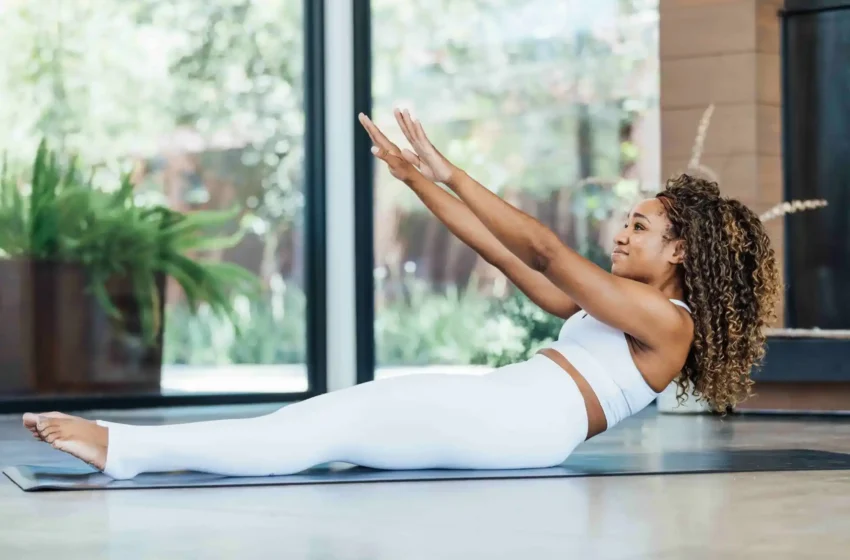
Pilates Roll Up Tips to Transform Your Abdominal Workout
Can you roll from lying down to sitting without using momentum or throwing your arms forward?
If not, you are not alone. The Pilates Roll Up is a classic movement that looks easy when an experienced practitioner performs it, yet it can quickly expose weaknesses in core control, mobility, and coordination.
Unlike a traditional sit-up, the roll-up is not simply about lifting your upper body as high as possible. The exercise asks you to move through your spine with control while your abdominal muscles help stabilize the pelvis and trunk.
That is what makes it so valuable.
In this guide, you will learn the correct Pilates Roll Up technique, how to breathe, why you may struggle with the movement, beginner modifications, useful progressions, and ways to include it in a complete Pilates routine.
What Is Pilates Roll Up?
The Pilates Roll Up is a mat Pilates exercise in which you move from a lying position to a seated position and then slowly return to the floor.
At first glance, it resembles a sit-up.
However, the movement is different in both purpose and execution.
A traditional sit-up often emphasizes lifting the torso toward the knees. The roll-up places more attention on controlled spinal movement, abdominal engagement, breathing, and smooth coordination.
The goal is not to get up quickly.
The goal is to control every part of the movement.
What muscles does the Pilates Roll Up work?
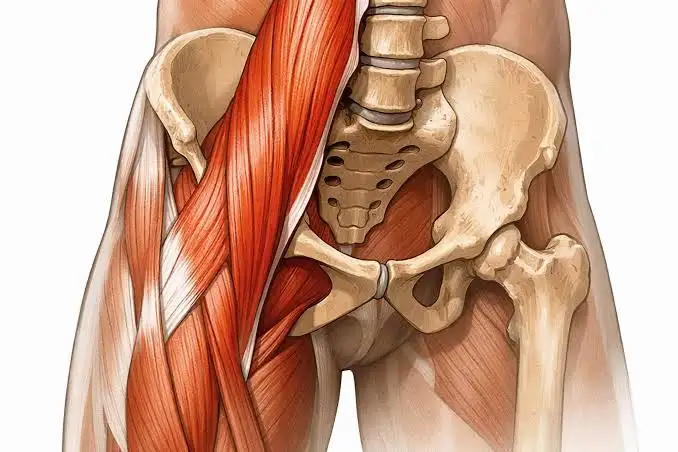
The exercise primarily challenges the muscles of the trunk, especially the abdominal muscles.
Depending on your technique and body position, it also involves:
- Hip flexors
- Deep abdominal muscles
- Rectus abdominis
- Obliques
- Spinal stabilizers
- Muscles supporting the pelvis
However, the roll-up should not be viewed as an isolated “six-pack exercise.”
Its bigger value is teaching your body to coordinate the trunk as you move through a large range of motion.
Why the Pilates Roll Up Is Harder Than It Looks
One reason the exercise is challenging is that you cannot rely on heavy external resistance.
Your body has to create the necessary tension.
Moreover, the movement starts from a mechanically difficult position: lying flat with the legs extended.
You must gradually lift your head, shoulders, upper back, and torso while controlling your pelvis.
Then comes the harder part.
You need to reverse the movement and lower yourself back to the floor without simply dropping down.
That eccentric control is a major part of the exercise.
Momentum is the biggest shortcut
Many people swing their arms forward to generate enough momentum to sit up.
This can make the exercise appear easier, but it changes the movement.
If you need to throw your arms forward to complete the roll-up, that is useful information.
It may mean you need to build more core strength, improve mobility, or use a modification.
How to Perform the Pilates Roll Up Correctly
Start by lying on your back on a comfortable exercise mat.
Extend your legs and keep them together or slightly apart, depending on your comfort and the instructions you are following.
Reach your arms toward the ceiling and then overhead without forcing your shoulders.
Take a controlled breath.
Step-by-step technique
- Set your starting position
Lie comfortably with your legs extended.
Keep your feet relaxed and avoid aggressively pointing your toes.
- Prepare your breath
Inhale naturally and prepare your trunk.
- Begin the curl
As you exhale, gently lift your head and upper shoulders from the mat.
Think about bringing your ribs toward your pelvis rather than simply throwing your chest upward.
- Continue forward
Gradually round through your spine as you move toward a seated position.
Your arms can reach forward.
- Pause with control
At the top, maintain a controlled position rather than collapsing toward your legs.
- Reverse the movement
Begin lowering your spine back toward the mat.
Move one section at a time.
- Return completely
Continue until your head and shoulders return to the mat.
That completes one repetition.
The entire movement should feel deliberate.
Pilates Roll Up Breathing Technique
Breathing can make a noticeable difference.
Many Pilates systems coordinate breathing with movement to improve control and awareness.
A common approach is to exhale while curling upward and inhale as you return, although exact breathing patterns can vary between instructors and methods.
The important point is not to hold your breath.
Why breathing matters
When people struggle with the exercise, they often tense their neck and shoulders.
Holding your breath can make that tension worse.
Instead, try to maintain a steady rhythm.
Think of your exhalation as helping you connect your rib cage and abdominal muscles while you move.
Do not force the breath.
A smooth breath is more useful than trying to make every repetition follow a rigid pattern.
Pilates Roll Up and Core Strength
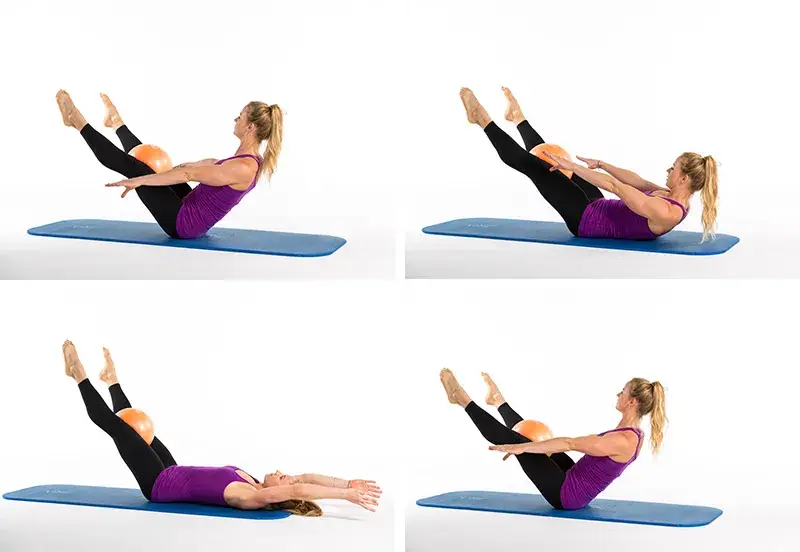
The roll-up can challenge your abdominal muscles, but it should not be reduced to a simple test of abdominal strength.
Someone may have strong abdominal muscles and still struggle with the movement.
Why?
Because the exercise also requires:
- Spinal mobility
- Hip mobility
- Pelvic control
- Coordination
- Hamstring flexibility
- Motor control
For example, tight hamstrings can make the seated position uncomfortable.
Limited spinal mobility can make it difficult to create the smooth curve required by the movement.
So if your roll-up is difficult, do not automatically assume your abs are weak.
The problem may be a combination of factors.
Common Pilates Roll Up Mistakes
Mistake 1: Throwing the arms forward
This is perhaps the most obvious compensation.
The arms create momentum instead of allowing the core to control the movement.
Fix: Slow the movement down and use a modified version if necessary.
Mistake 2: Pulling on the neck
Some people try to lift their head by tightening the neck.
This can create unnecessary discomfort.
Fix: Think about lifting through the upper torso while keeping the neck relaxed.
Mistake 3: Bending the knees unexpectedly
When the hamstrings are tight, the legs may lift or bend as you roll up.
Fix: Try a bent-knee variation or place the feet against a stable surface.
Mistake 4: Dropping back down
Getting to the top is only half the exercise.
The return phase is equally important.
Fix: Lower slowly and try to maintain control throughout the descent.
Mistake 5: Forcing the movement
Not everybody will perform the exercise in exactly the same way.
Do not force your spine into a shape that feels painful or unnatural.
Why You May Not Be Able to Do a Pilates Roll Up
If you cannot perform a full Pilates Roll Up, there are several possible reasons.
Limited hamstring flexibility
Tight hamstrings can make the seated position difficult.
Limited spinal mobility
The roll-up requires the spine to move through a controlled flexion pattern.
Insufficient trunk control
You may not yet have the strength or coordination needed to control the movement.
Poor technique
Sometimes the issue is not strength at all.
A small change in arm position, breathing, or pelvic control can make a significant difference.
Body proportions
People have different limb and torso lengths.
This can influence how the movement feels.
Therefore, avoid comparing your form directly with someone else’s.
Beginner Pilates Roll Up Modifications
You do not need to perform the full exercise immediately.
Modifications are not failures.
They are tools for developing the necessary strength and control.
Bent-knee roll-up
Keep your knees bent and feet supported.
This can reduce the demand placed on the abdominal muscles and hamstrings.
Half roll-back
Sit with your knees bent.
Slowly roll your spine backward only part of the way, then return.
This helps you practice spinal control without completing the full movement.
Assisted roll-up
A resistance band or strap can sometimes provide assistance, depending on how it is used.
The goal is to gradually reduce assistance as your control improves.
Towel or mat assistance
A folded towel placed along the spine can sometimes make the transition easier by slightly changing the starting position.
However, use modifications only when they are appropriate for your body and training method.
Pilates Roll Up Progression
Progress should be gradual.
Instead of repeatedly attempting the hardest version, build the movement in stages.
Stage 1: Core activation
Learn to control your abdominal muscles while lying on your back.
Stage 2: Partial roll-back
Practice moving your spine backward and forward with control.
Stage 3: Assisted roll-up
Use appropriate support to practice the full movement.
Stage 4: Full roll-up
Attempt the traditional version when you can control the earlier stages.
Stage 5: Slow eccentric lowering
Once you can perform the full movement, make the lowering phase slower.
This increases the control challenge without requiring additional equipment.
How Many Pilates Roll Ups Should You Do?
Quality matters more than quantity.
For beginners, 3–6 controlled repetitions may be enough.
More experienced practitioners may perform additional repetitions depending on the workout.
However, if your form deteriorates after several repetitions, stop the set.
There is little benefit in completing 20 poor-quality repetitions simply because a workout video recommends that number.
A controlled repetition is more valuable.
Pilates Roll Up vs. Sit-Up
The two movements may look similar, but their training goals can differ.
| Pilates Roll Up | Traditional Sit-Up |
| Emphasizes spinal control | Often emphasizes trunk lifting |
| Uses slower movement | Can be performed faster |
| Focuses on coordination | Often focuses on repetition |
| Strong breathing component | Breathing varies |
| Requires controlled descent | Descent may be less emphasized |
Neither movement is automatically better.
They simply train movement differently.
The roll-up is particularly useful when the goal is to develop controlled trunk movement and Pilates-style body awareness.
Pilates Roll Up in a Full Pilates Routine
The roll-up works best when it is part of a broader program.
A complete Pilates session may include:
- Breathing exercises
- Spinal mobility
- Core stabilization
- Leg work
- Hip exercises
- Upper-body movements
- Balance work
- Stretching
The roll-up can fit into the middle of a session after your body has warmed up.
This can make the movement feel more comfortable than attempting it immediately after lying down.
Using Pilates Reformers to Build Core Control
While the roll-up is traditionally associated with mat Pilates, reformer training can offer different ways to develop trunk control.
Pilates Reformers use resistance and a moving carriage to challenge the body in different positions.
A reformer session may include exercises that strengthen the abdominal and hip muscles without requiring a full roll-up.
This can help beginners build a broader foundation.
Pilates Reformer Workout and the roll-up
A Pilates Reformer Workout can complement mat-based core exercises.
For example, you might perform reformer footwork, controlled leg movements, abdominal exercises, and then finish with a few carefully selected mat exercises.
This creates variety without forcing one exercise to do everything.
Portable Equipment for Pilates Training
You do not necessarily need a large studio setup to practice Pilates.
A Portable Pilates Reformer can provide resistance-based Pilates training at home.
However, a mat remains the simplest option for practicing the roll-up.
A mat provides enough cushioning to make the movement more comfortable while allowing you to focus on spinal control.
What about the Aero Pilates Reformer?
An Aero Pilates Reformer can be another home-based option for people interested in reformer-style exercise.
However, the roll-up itself remains a mat exercise.
The reformer can complement your training, but it does not make correct roll-up technique unnecessary.
Pilates Ring Exercises and Core Training
Small Pilates equipment can also add variety.
Pilates Ring Exercises can challenge the inner thighs, glutes, chest, arms, and core.
For example, holding the ring between your hands while performing a controlled core movement can add an upper-body stability challenge.
However, additional equipment is not required to learn the roll-up.
Master the movement first.
Then add equipment only when it has a clear training purpose.
Pilates Roll Up and Different Fitness Levels
Beginners
Focus on modifications and partial movements.
Your goal should be learning control.
Intermediate practitioners
Work toward a full roll-up with smooth breathing and a controlled descent.
Advanced practitioners
Experiment with slower tempo, longer pauses, and more demanding Pilates sequences.
However, advanced does not mean performing every movement as quickly or dramatically as possible.
Control remains the foundation.
How to Add the Pilates Roll Up to Your Weekly Routine
You can practice the movement two or three times per week as part of a broader Pilates program.
For example:
Monday: Full-body Pilates
Tuesday: Walking or cardio
Wednesday: Core-focused Pilates
Thursday: Recovery
Friday: Reformer Pilates
Saturday: Strength training
Sunday: Mobility or rest
You do not need to perform roll-ups every day.
Your abdominal muscles are involved in many other movements.
Recovery still matters.
The Modern Pilates Landscape
The popularity of Pilates has created many different training styles.
You may see boutique programs such as Jet Set Pilates, online classes, mat workouts, reformer sessions, and home equipment.
However, brand popularity should not replace basic training principles.
Look for:
- Clear instruction
- Appropriate progressions
- Beginner options
- Safe movement cues
- Qualified professionals
- Realistic fitness claims
A good workout should help you understand your body rather than encourage you to chase increasingly difficult movements simply for appearance.
How to Improve Your Pilates Roll Up at Home
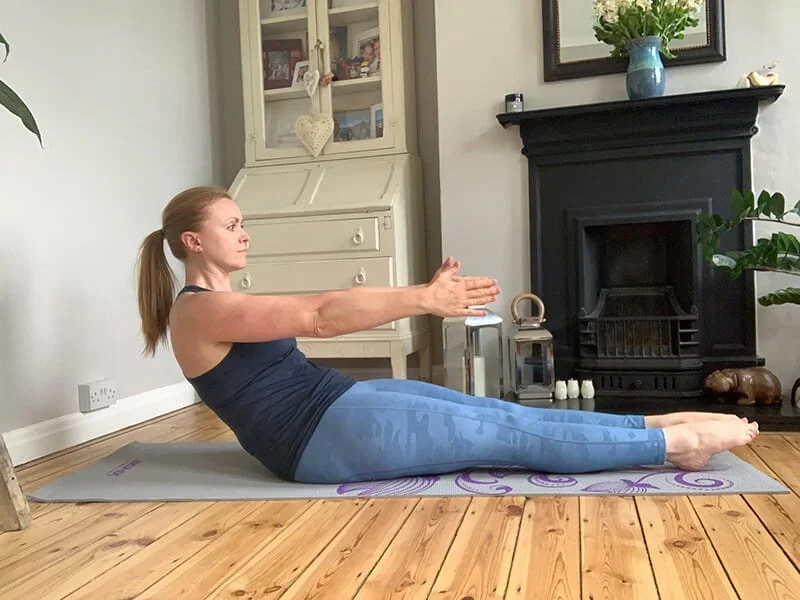
You can make progress without spending hours practicing the same exercise.
Try these strategies:
Practice partial movements
Build control gradually.
Work on hamstring mobility
Gentle, consistent mobility work may make the seated position more comfortable.
Strengthen the core in different positions
Include planks, dead bugs, bridges, and other controlled movements as appropriate.
Slow down
Try taking longer to lower your spine.
Record your technique
If safe and practical, filming yourself from the side can help you notice movement patterns that are difficult to feel.
However, video is not a replacement for professional coaching when you need technique correction.
Personal Insight: Stop Chasing the Perfect Roll Up
One of the most useful lessons in Pilates is that the goal is not to make every movement look perfect immediately.
People often compare themselves with advanced practitioners online.
That comparison can be misleading.
An experienced Pilates practitioner may have years of training behind a movement that appears effortless.
Instead, focus on your own progression.
Maybe you can roll halfway back today.
Perhaps next month you can control three-quarters of the movement.
Eventually, you may complete the full exercise with steady breathing.
That is meaningful progress.
Safety Tips for the Pilates Roll Up
The exercise should challenge your muscles without causing sharp or unusual pain.
Keep these points in mind:
- Use a supportive exercise mat.
- Move slowly.
- Avoid pulling on your neck.
- Do not force spinal movement.
- Stop when your technique breaks down.
- Use modifications when necessary.
- Avoid holding your breath.
If you have persistent back pain, an injury, recent surgery, or another health concern, speak with an appropriate healthcare professional before starting a new exercise routine.
Conclusion
The Pilates Roll Up is much more than a basic abdominal exercise.
It combines core strength, spinal control, breathing, coordination, flexibility, and body awareness in one carefully controlled movement.
However, it is also an exercise that can expose weaknesses.
If you struggle with the roll-up, do not immediately assume that your abs are not strong enough. Hamstring flexibility, spinal mobility, technique, body proportions, and coordination can all influence your performance.
The smartest approach is to progress gradually.
Use bent-knee versions, partial roll-backs, or other modifications when necessary. Focus on breathing and control. Most importantly, avoid using momentum to force yourself through the movement.
In short, a good Pilates Roll Up is not about getting up quickly. It is about controlling the journey from the floor to the seated position—and controlling the return just as carefully.
FAQs About the Pilates Roll Up
What is the Pilates Roll Up good for?
The Pilates Roll Up can develop core strength, trunk control, spinal mobility, coordination, and body awareness when performed with appropriate technique.
Why can’t I do a Pilates Roll Up?
Difficulty may come from limited core control, tight hamstrings, spinal mobility, technique, or individual body proportions. A modified version can help you build the required skills.
Is the Pilates Roll Up better than a sit-up?
They have different movement goals. The roll-up emphasizes controlled spinal movement and coordination, while traditional sit-ups often place greater emphasis on repeatedly lifting the torso.
How many Pilates Roll Ups should beginners do?
Start with around 3–6 controlled repetitions. Increase gradually as your technique improves rather than chasing a high repetition count.
Can Pilates Roll Ups flatten your stomach?
The exercise can strengthen the abdominal muscles, but it cannot specifically remove belly fat. Body composition is influenced by overall nutrition, activity, genetics, sleep, and energy balance.
⭐ Make MindLiva Your Preferred Source on Google
Get trusted health, wellness, and lifestyle articles from MindLiva.
Add MindLiva
Samie Babaei is a medical science student at Shahid Beheshti University of Medical Sciences with a strong interest in health, wellness, and medical research. As a health writer and researcher at MindLiva, she focuses on creating clear, evidence-based content that helps readers better understand health and well-being.