



Normal Black Line on Nail vs Melanoma: Early Detection Tips
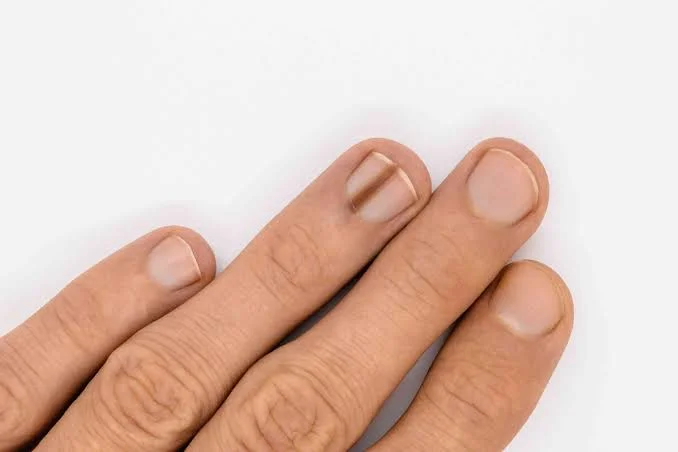
Have you noticed a brown or black streak running from the base to the tip of a fingernail or toenail? It is natural to feel worried, especially when online photographs show many different-looking nail conditions.
Understanding the normal black line on nail vs melanoma starts with one important fact: most dark nail marks are not cancer. Pigment can develop because of natural skin tone, an old injury, medication, infection, friction, or a harmless mole beneath the nail.
However, a new line on one nail, especially one that grows wider or changes color, deserves professional attention. This article explains common causes, warning features, examination methods, biopsy, treatment, and the practical steps to take when a nail streak does not look normal.
What Causes a Black Line on a Nail?
A vertical brown or black band is medically known as longitudinal melanonychia. The color develops when pigment called melanin becomes visible within the nail plate.
The pigment is usually produced in the nail matrix, the tissue beneath the base of the nail that forms new nail cells. As the nail grows, the pigment travels forward in a line.
Several harmless conditions can cause this pattern:
- Natural pigmentation associated with skin tone
- Repeated pressure from tight shoes
- Nail biting or picking
- A previous finger or toe injury
- Pregnancy-related hormone changes
- Certain prescription medicines
- Fungal or bacterial infection
- Inflammatory skin problems
- A harmless mole or freckle in the nail matrix
Natural nail pigmentation commonly affects more than one finger or toe. It may also produce bands that remain similar in width, shade, and shape over a long period.
Still, no single feature can guarantee that a line is harmless. A dermatologist needs to consider the person’s age, health history, skin tone, medicine use, injuries, and changes seen over time.
Could It Simply Be a Bruise?
Blood trapped under a nail after trauma can look dark red, brown, purple, or black. You may remember hitting the finger, dropping something on a toe, running a long distance, or wearing shoes that pressed against the nail.
A bruise normally moves toward the tip as the nail grows. New, clear nail should slowly appear near the cuticle. In contrast, pigment produced continuously in the nail matrix often remains connected to the nail base.
However, not everyone remembers an injury. Cancer can also bleed, so a history of trauma should not automatically end the investigation when the mark persists or changes.
Normal Black Line on Nail vs Melanoma: Main Differences
No home checklist can diagnose a nail tumor. Nevertheless, certain patterns can help you decide whether to arrange a prompt skin examination.
A relatively reassuring line may:
- Have been present without change for years
- Appear on several nails in a similar way
- Have a uniform light-brown color
- Have smooth, parallel borders
- Move outward after a known injury
- Match natural pigment changes in other nails
A potentially concerning line may:
- Be new in an adult
- Affect only one nail
- Become wider over weeks or months
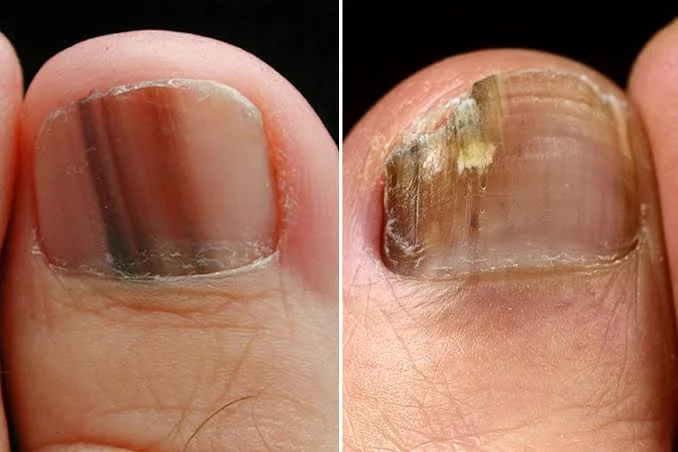
- Have blurred or uneven borders
- Contain brown, gray, and black areas
- Be wider near the cuticle
- Extend onto nearby skin
- Split, lift, or damage the nail
- Develop a lump, sore, or bleeding area
DermNet notes that suspicious bands may widen beyond 3 millimeters, become irregular, or spread into the surrounding nail fold. However, these features guide assessment rather than confirm a diagnosis.
Compare the Patterns
| Feature | Often Benign | Needs Medical Review |
| Number of nails | Several similar nails | One newly affected nail |
| Color | Even light or medium brown | Mixed brown, gray, or black |
| Border | Straight and clear | Blurred, broken, or irregular |
| Width | Stable | Becoming wider |
| Nail structure | Smooth and intact | Cracked, lifted, or distorted |
| Nearby skin | No new pigment | Color spreading past the nail |
| Development | Long-term and unchanged | New or evolving |
This comparison is useful for awareness, not self-diagnosis. Some harmless bands can look unusual, while an early cancerous band may appear narrow and neat.
Warning Signs That Should Not Be Ignored
Dermatologists often use the ABCDEF approach when assessing a pigmented nail. It is not a perfect test, but it helps organize the warning features.
- A — Age and ancestry: Risk is often considered more carefully in adults aged 50 to 70, although the disease can develop at other ages.
- B — Band: A brown-black band may be wide, irregular, or blurred.
- C — Change: The mark grows, darkens, or fails to improve after treatment.
- D — Digit: The thumb, big toe, and index finger are common sites.
- E — Extension: Pigment spreads onto the skin beside the nail.
- F — Family history: Personal or family history may raise concern.
The American Academy of Dermatology also advises checking for nail lifting, splitting, a bump beneath the plate, or darker skin around the nail.
What Is the Hutchinson Sign?
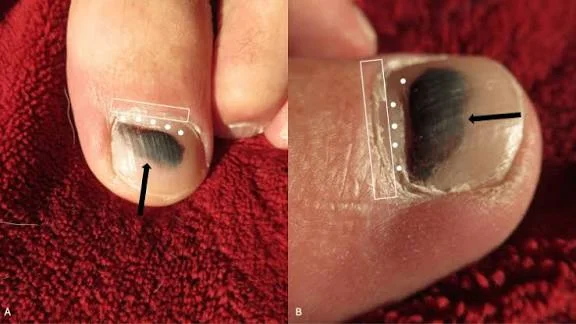
The Hutchinson sign means brown or black pigment extends from the nail plate onto the skin near the cuticle or side of the nail. It can be an important warning feature.
However, pigment around the nail is not always cancer. Harmless conditions can create a similar appearance, sometimes called a pseudo-Hutchinson sign. Therefore, the finding must be interpreted by an experienced clinician.
Can a Cancerous Nail Be Colorless?
Yes. amelanotic melanoma contains little or no visible dark pigment. Under or around a nail, it may appear as a pink, red, pale, ulcerated, or wart-like growth.
This is one reason color alone is unreliable. A lasting lump, unexplained nail destruction, or a sore that repeatedly bleeds also needs assessment.
Who Can Develop a Suspicious Nail Lesion?
Anyone can develop cancer in the nail unit. Unlike many sun-related skin tumors, this uncommon type does not appear to have a strong connection with ultraviolet exposure.
Natural nail bands are especially common in people with deeply pigmented skin. As a result, most bands in this group are not dangerous.
However, delayed recognition can occur when a serious change is assumed to be normal pigment. The American Academy of Dermatology stresses that skin cancer in darker skin tones may appear on the palms, soles, fingers, toes, or nails—areas that receive little sun.
The practical lesson is balance. Natural pigmentation should not cause panic, but a new, changing, damaged, or clearly different nail should not be dismissed.
Is Every Dark Nail Streak a Subungual Melanoma?
No. subungual melanoma begins below the nail plate, often from pigment-forming cells in the nail matrix. It is uncommon compared with bruises, natural pigment, and other nail disorders.
The broader medical term includes tumors arising in the matrix, beneath the plate, or in the skin beside the nail. The thumb and big toe are frequently affected, but any finger or toe can be involved.
The phrase nail melanoma is often used online for all of these locations. Although the wording is convenient, the precise starting point matters when a specialist plans biopsy and surgery.
How a Dermatologist Examines a Dark Nail Line
The appointment usually begins with a detailed history. The dermatologist may ask:
- When did you first notice the line?
- Has it become wider or darker?
- Did the nail suffer an injury?
- Are other nails affected?
- Which medicines and supplements do you take?
- Is there pain, bleeding, splitting, or lifting?
- Do you have a personal or family cancer history?
The doctor will examine all fingernails and toenails, not just the affected one. Comparing nails can help distinguish a single unusual lesion from a general pigment pattern.
Dermoscopy and Nail Photography
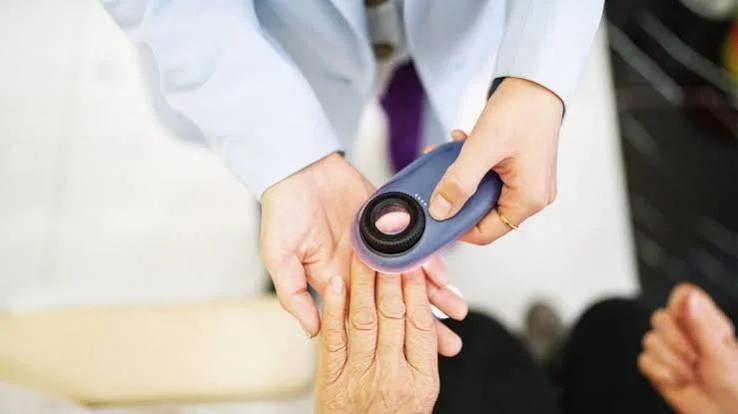
A dermatoscope is a handheld tool that magnifies the nail and uses special light to show structures that are difficult to see with the naked eye.
Concerning dermoscopic features may include lines that differ in color, width, spacing, or direction. Gray-black color, nail damage, surrounding pigment, and a band covering much of the plate may also increase concern.
Clear photographs with measurements may be taken. When immediate biopsy is not required, the doctor may compare these images at a planned follow-up visit.
Monitoring should have a clear schedule. Simply waiting without medical review is not the same as professional observation.
Why Biopsy Is the Decisive Test
Visual examination can estimate risk, but biopsy is the only way to establish whether cancer cells are present. The sample is examined under a microscope by a pathologist or dermatopathologist.
For a pigmented nail band, the biopsy may need to include part of the nail matrix or nail bed. The exact method depends on the line’s width, position, and most suspicious area.
Because the nail matrix produces the nail plate, poor technique can lead to permanent splitting or altered nail growth. Therefore, biopsy is best performed by a dermatologist or surgeon experienced with nail-unit procedures.
Do not cut deeply beneath the nail, burn the area, or repeatedly cover it with home remedies. Such actions can cause infection, damage useful tissue, and delay an accurate diagnosis.
What Happens If Cancer Is Found?
Treatment depends on whether abnormal cells remain near the surface or have grown deeper. The pathology report may describe tumor thickness, ulceration, cell division, surgical margins, and other features.
early stage melanoma in the nail may sometimes be treated through careful removal of the nail apparatus while preserving the finger or toe. More invasive disease may require wider surgery, and some cases may still need partial or complete removal of the end of the digit.
Doctors may also consider a sentinel lymph-node biopsy when the tumor’s depth or other features suggest a risk of lymphatic spread.
If metastatic melanoma is diagnosed, treatment may involve immunotherapy, targeted medicine when a useful gene change is present, radiation, surgery, or a clinical trial. The plan is normally developed by a multidisciplinary cancer team.
Why Early Detection Changes the Outlook
Nail-unit tumors are often found later than more visible skin lesions. A dark streak may be blamed on injury or fungus, while a painless change can feel unimportant.
Yet stage at diagnosis strongly affects outcomes. Current SEER data show a five-year relative survival rate of 100% for localized cutaneous disease, compared with 34% after distant spread. These broad figures are not specific to nail tumors and cannot predict one patient’s outcome, but they show the value of early assessment.
A practical insight from dermatology guidance is that change matters more than perfection. You do not need to decide whether a band looks exactly like a medical photograph. You only need to notice that it is new, different, damaged, or evolving and arrange an examination.
Nail Changes Versus Other Melanoma Types
Search results often mix very different conditions. nodular melanoma usually presents as a fast-growing raised skin lesion rather than a simple nail streak.
Similarly, ocular melanoma begins in pigment cells within or around the eye. It is not diagnosed through a nail examination.
The term skin melanoma describes a cutaneous tumor, while melanoma skin cancer is a common public-facing name for the same broad disease group. malignant melanoma is another name still used in some records and older articles.
People also search what does melanoma look like on the skin, but no single color, shape, or picture covers every case. Doctors look at evolution, structure, symptoms, and biopsy results.
Likewise, searches for signs of melanoma should include less obvious areas such as the scalp, palms, soles, between the toes, and around the nails.
The question how fast does melanoma spread cannot be answered with one timeline. Speed and risk depend on tumor depth, ulceration, subtype, growth pattern, and whether abnormal cells have reached lymph nodes or distant organs.
How to Check Your Nails at Home
A brief monthly check can make changes easier to notice.
Step 1: Remove Nail Polish
Examine bare nails in bright, natural light. Check the plate, cuticle, side folds, and skin beneath the free edge.
Step 2: Compare Both Hands and Feet
Look for one nail that appears different from the others. Notice new bands, dark patches, lifting, splitting, or a persistent sore.
Step 3: Take a Clear Photograph
Photograph the nail from the same angle with the date recorded. Place a small ruler beside it when possible.
Step 4: Watch the Direction of Movement
A bruise should gradually travel toward the nail tip as new nail grows. A band that continues to begin at the cuticle needs assessment.
Step 5: Seek Care for Change
Do not wait for pain. The disease can be painless, and early nail changes may be subtle.
When Should You Book an Appointment?
Arrange a dermatologist visit when a line:
- Appears suddenly without a clear cause
- Develops on one nail in adulthood
- Widens or darkens
- Has mixed colors or irregular edges
- Extends onto nearby skin
- Causes splitting, lifting, bleeding, or a lump
- Does not move outward like a bruise
- Persists despite treatment for infection
- Looks clearly different from bands on other nails
You do not need to treat every nail mark as an emergency. However, a changing pigmented band should not be left for months while trying antifungal products without a confirmed diagnosis.
Conclusion
Comparing normal black line on nail vs melanoma involves more than looking at color. Harmless bands are often stable, even, and present on several nails, while concerning changes may be new, irregular, widening, or associated with damaged skin and nail tissue.
Still, appearance cannot provide certainty. A dermatologist can assess the full pattern, use dermoscopy, monitor documented changes, and arrange a properly placed biopsy when needed.
The best takeaway is simple: stay calm, but respect change. Most dark nail streaks have non-cancerous causes. Nevertheless, early professional review is the safest way to protect both your health and your peace of mind.
Frequently Asked Questions
Can a harmless black line stay on a nail for years?
Yes. Natural pigmentation, a harmless mole, or other benign causes may create a stable long-term band. A dermatologist should still assess a new or changing line.
Does a cancerous nail line always become wider?
Not always. Widening is a warning feature, but some serious bands remain narrow. Changes in color, border, nearby skin, or nail structure can also matter.
Will a dark nail bruise grow out?
Usually, yes. As the nail grows, a bruise should move toward the tip, leaving clearer nail near the cuticle. Seek care when it remains fixed or behaves unexpectedly.
Can nail fungus create a dark line?
Yes. Some fungal infections can cause brown or black discoloration. However, infection and a tumor can look alike, so persistent pigment should be medically examined.
Should I wait to see whether the line changes?
A long-standing, medically assessed band may be monitored. A new unexplained streak, especially on one nail, should be examined rather than watched without professional guidance.
⭐ Make MindLiva Your Preferred Source on Google
Get trusted health, wellness, and lifestyle articles from MindLiva.
Add MindLiva
Samie Babaei is a medical science student at Shahid Beheshti University of Medical Sciences with a strong interest in health, wellness, and medical research. As a health writer and researcher at MindLiva, she focuses on creating clear, evidence-based content that helps readers better understand health and well-being.