



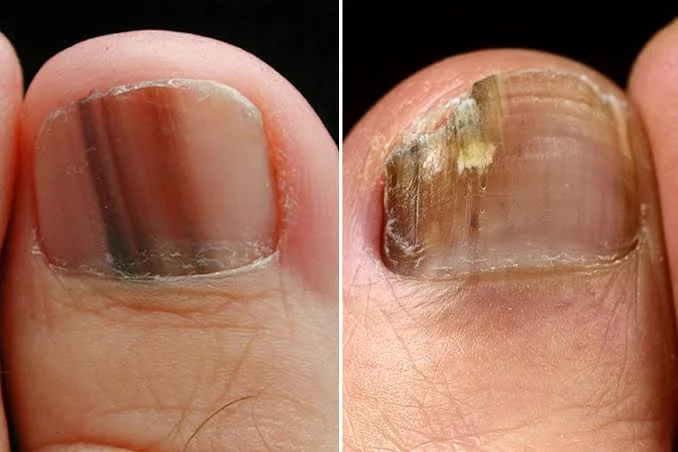
Nail Melanoma vs. Nail Fungus: Key Differences Explored
Have you ever noticed a dark line, brown patch, or unusual color developing on a fingernail or toenail and wondered whether it was simply an infection?
That question matters because nail changes have many possible causes. Trauma, pigmentation, medication, and fungal infections can all alter the appearance of a nail. However, in some cases, a persistent dark band can be a warning sign of nail melanoma, a rare cancer that develops in the nail unit.
The challenge is that harmless pigmentation and early cancer can look surprisingly similar. Therefore, looking at color alone is not enough.
In this guide, you will learn how to compare nail melanoma with nail fungus, which changes deserve attention, what doctors look for during examination, and why a new or changing pigmented nail should not automatically be treated as fungus.
What Is Nail Melanoma?

Nail melanoma is a rare form of cancer involving pigment-producing cells in the nail unit. It can begin in the nail matrix, nail bed, or nearby skin. A common presentation is a brown or black vertical band running along one nail.
The condition is sometimes called subungual melanoma when it develops beneath the nail or originates from the nail matrix.
Interestingly, unlike many forms of skin cancer, nail-unit melanoma does not appear to be mainly linked to ultraviolet exposure. It can occur on fingers or toes, with the thumb and great toe among the most commonly affected sites.
Although it is rare, the condition deserves attention because early lesions may be difficult to distinguish from benign nail pigmentation.
Why a dark nail line does not always mean cancer
A dark streak is not automatically dangerous.
Melanonychia, the medical term for brown or black pigmentation of the nail, has many causes. These include previous injury, benign moles, repeated pressure, medications, inflammatory conditions, fungal infections, and natural pigmentation.
For example, someone who repeatedly injures a toenail with tight shoes may develop discoloration that looks alarming but is not cancerous.
The key issue is change over time.
Nail Melanoma vs. Nail Fungus: The Key Differences
Nail fungus is far more common than nail melanoma. Fungal nail disease, also called onychomycosis, often affects toenails and can gradually make them thick, brittle, yellow, white, brown, or even black. Fungal melanonychia can specifically produce brownish or blackish pigmentation.
However, the pattern of the change can provide useful clues.
| Feature | Nail Melanoma | Nail Fungus |
| Typical color | Brown, black, gray, or mixed pigmentation | Yellow, white, brown, or sometimes black |
| Pattern | Often a longitudinal band | Often diffuse or irregular discoloration |
| Number of nails | Frequently one nail | Often multiple nails, especially toes |
| Nail thickness | May initially be normal | Often becomes thick |
| Nail texture | May crack, split, or become distorted | Frequently brittle, crumbly, or rough |
| Surrounding skin | Pigment may extend onto nail folds | Usually no dark pigment spreading onto surrounding skin |
| Progression | May gradually widen or become more irregular | Often slowly causes thickening and discoloration |
| Diagnosis | May require dermoscopy and biopsy | May involve examination and fungal testing |
This comparison is useful, but it should not be used as a home diagnostic test. Some fungal infections can create dark pigmentation, while some nail-unit cancers can look very different from the classic black stripe.
Nail melanoma can change gradually
One of the most important clues is evolution.
A suspicious pigmented band may start narrow and then become wider, darker, or less regular. DermNet notes that concerning changes can include increasing width, irregular pigmentation, blurred borders, nail distortion, bleeding, or extension of pigment onto nearby skin.
For this reason, taking a clear photograph of a new nail change and comparing it over several weeks can be useful information to share with a healthcare professional.
What Does Nail Melanoma Look Like?
People often search normal black line on nail vs melanoma because they want to know whether a dark stripe is harmless.
Unfortunately, there is no single visual feature that can confirm the diagnosis at home.
A benign pigmented line may remain stable for years, have an even color, and maintain a relatively regular pattern. A suspicious lesion may become wider, show several shades of brown or black, develop uneven lines, or affect the surrounding nail fold.
Another important point is that nail pigmentation can occur naturally, particularly in people with darker skin tones. Multiple nails showing similar pigmentation can have a different significance from a new, isolated band appearing on one nail.
Signs that deserve a closer look
Important warning features include:
- A new dark band on one nail
- A band that becomes wider over time
- Uneven shades of brown, gray, or black
- Irregular or blurred borders
- Pigment extending onto the skin beside the nail
- Nail splitting or distortion
- A mass developing under the nail
- Bleeding or ulceration without a clear injury
- Persistent changes that do not grow out with the nail
These are among the signs of melanoma that warrant professional assessment, although none of them alone proves cancer.
How Nail Fungus Usually Looks
Fungal nail infections usually behave differently.
A typical infection can make a nail thicker, more fragile, discolored, or crumbly. The nail may separate partially from the nail bed, and debris can accumulate underneath it.
Toenails are affected more often than fingernails. In fact, Cleveland Clinic estimates that about 10% of the general population experiences fungal nail disease at some point, with rates increasing substantially with age.
However, fungal infections are not always obvious. Some species can produce dark pigmentation, creating a situation where a fungal infection resembles a pigmented nail lesion.
That is why automatically assuming that every dark nail is fungus can be a mistake.
Why One Nail Can Be More Concerning
When doctors assess a pigmented nail, they consider the number of nails affected.
A similar pigment pattern across several nails may suggest a benign or systemic cause. By contrast, a new pigment band affecting a single nail in an adult deserves careful assessment, particularly when it is changing. DermNet specifically highlights recent pigmentation affecting one nail as a reason to consider nail-unit melanoma.
This does not mean that every single-nail streak is cancer.
A benign mole, injury, medication, or other condition can also affect one nail. The point is that the cause should be established rather than guessed.
Nail Melanoma and the Hutchinson Sign
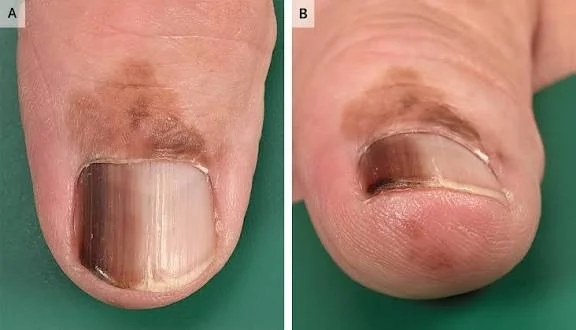
One classic clinical feature is called the Hutchinson sign.
This refers to pigmentation extending from beneath the nail into the surrounding nail fold or cuticle area. It can be an important warning sign, but it is not proof of cancer because similar-looking pigmentation can occur in benign conditions.
There is also a phenomenon called a pseudo-Hutchinson sign, where the appearance of pigment around the nail is caused by the underlying anatomy or transparency rather than actual pigment spreading into the surrounding skin.
Therefore, a dermatologist may use dermoscopy to examine the nail more closely.
How Doctors Diagnose a Suspicious Nail Change
A healthcare professional may begin by asking several questions:
- When did the discoloration first appear?
- Has its size or color changed?
- Was there an injury before it appeared?
- Are other nails affected?
- Is there pain, bleeding, or nail distortion?
- Is there pigmentation around the nail?
- Have medications or health conditions changed recently?
A dermatoscope can provide a much closer view of pigment patterns that are difficult to see with the naked eye.
If the appearance remains suspicious, a biopsy may be recommended. Histopathological examination is important because visual examination alone cannot definitively establish whether cancer cells are present.
Why you should not remove a suspicious nail yourself
Trying to scrape, file, cut, or chemically treat a suspicious dark area can make the situation harder to evaluate.
Likewise, starting antifungal treatment without confirming the diagnosis may delay appropriate assessment if the discoloration has another cause.
A dermatologist can decide whether testing is needed and what type of examination is appropriate.
Can Nail Melanoma Be Amelanotic?
Yes. Not every nail-unit cancer contains obvious dark pigment.
Amelanotic melanoma is a form that produces little or no visible melanin. In the nail, this can make diagnosis particularly challenging because the lesion may appear pink, red, flesh-colored, or like a non-pigmented growth. DermNet notes that nail-unit lesions can be hypomelanotic or amelanotic in a substantial proportion of cases.
Therefore, the absence of black pigment does not automatically rule out a serious nail lesion.
Persistent growth, bleeding, ulceration, unexplained nail destruction, or a new mass should be assessed even when the lesion is not dark.
Is Nail Melanoma the Same as Skin Melanoma?
They are related conditions because both arise from pigment-producing cells, but their location and clinical presentation differ.
Skin melanoma typically appears as a changing pigmented lesion on the skin. The familiar ABCDE approach—Asymmetry, Border irregularity, Color variation, Diameter, and Evolution—can help people recognize suspicious skin lesions.
People sometimes ask, what does melanoma look like on the skin? It can vary considerably. Some lesions have multiple colors or irregular borders, while others may not show every classic ABCDE feature.
Moreover, pigmented cancers can occur in places people do not routinely inspect, including the nails.
Other Types of Melanoma: Why the Terms Can Be Confusing
Medical articles may mention different forms of melanoma, but these terms do not all describe nail disease.
For example, nodular melanoma is a more rapidly growing subtype that commonly appears as a raised lesion on the skin.
Malignant melanoma is another term used to describe a cancerous melanoma. Meanwhile, ocular melanoma develops in pigment-containing tissues of the eye rather than the nail.
These distinctions matter because symptoms, risk factors, diagnosis, and treatment can vary depending on where the disease begins.
Similarly, metastatic melanoma refers to disease that has spread from its original site to other parts of the body. It is not a description of every suspicious nail streak.
How Fast Does Melanoma Spread?
People frequently search how fast does melanoma spread, but there is no single timeline that applies to every case.
Some melanomas can grow quickly, while others develop more slowly. The behavior depends on factors such as the tumor type, thickness, depth, and whether cancer cells have reached other tissues.
For nail-unit lesions, delayed diagnosis can be particularly problematic because early changes may resemble trauma or infection. DermNet emphasizes the difficulty of distinguishing early nail-unit lesions from benign causes.
The practical takeaway is simple: do not wait for a suspicious nail lesion to become painful before seeking medical advice.
What About Early Stage Melanoma?
When a suspicious lesion is identified at an early stage melanoma presentation, treatment decisions are generally more straightforward than when disease has already spread.
For melanoma overall, surgery is a central treatment approach when the tumor can be completely removed. Further treatment depends on the stage and other clinical findings.
This is one reason awareness matters. Recognizing a persistent, changing nail lesion does not mean assuming the worst. It means giving a healthcare professional the opportunity to investigate it while the problem is still potentially localized.
Personal Insight: A Simple Nail-Check Habit
One practical habit I recommend for health-conscious readers is to check their nails during ordinary grooming rather than waiting for symptoms.
Look at the fingernails and toenails under good lighting. Pay attention to new lines, changes in color, widening bands, nail distortion, or pigment extending onto nearby skin.
For example, if a narrow brown line appeared after repeated pressure from footwear, photograph it and monitor how it changes as the nail grows.
If the mark persists, expands, becomes irregular, or has no clear explanation, take those photographs to a dermatologist. A timeline can sometimes be surprisingly helpful during a clinical assessment.
When Should You See a Dermatologist?

Consider arranging a professional examination if:
- A new dark streak appears on one nail.
- The streak becomes wider or darker.
- The pigment has several uneven colors.
- The surrounding skin becomes pigmented.
- The nail begins splitting, lifting, or changing shape.
- A lump appears under the nail.
- The nail bleeds without an obvious injury.
- A suspected fungal infection does not improve as expected.
- You are unsure whether a nail change is normal.
Importantly, do not panic when you see a dark nail mark. Most unusual nail changes have causes other than cancer. However, persistent or evolving changes deserve an appropriate diagnosis.
Conclusion
Nail discoloration can be surprisingly difficult to interpret. A yellow, thickened toenail may point toward a fungal infection, while a new or changing brown-black band on one nail may require a closer look.
The most important lesson is that appearance alone cannot reliably separate benign pigmentation, fungal melanonychia, trauma, and nail melanoma.
Watch for change, widening, irregular pigmentation, nail destruction, bleeding, or pigment extending onto nearby skin. When a nail change is persistent or unexplained, professional assessment is the safest next step.
In short, awareness does not mean becoming alarmed by every dark line. It means knowing when an ordinary nail change deserves a second look—and acting early when something does not seem right.
FAQs
Is every black line on a nail nail melanoma?
No. Dark nail lines can result from benign pigmentation, trauma, medications, fungal infection, or other conditions. However, a new or changing single-nail band should be assessed by a healthcare professional.
Can nail fungus look like nail melanoma?
Yes. Certain fungal infections can cause brown or black pigmentation, known as fungal melanonychia. Because the appearances can overlap, testing or dermatological examination may be necessary.
Does nail melanoma always cause pain?
No. Early lesions may be painless. Pain, bleeding, nail distortion, or a growing mass can occur later, but the absence of pain does not rule out a serious condition.
Can a normal black line on a nail become cancerous?
A benign pigmented nail line does not simply become cancerous in every case. The important concern is a new or changing pigmented lesion whose cause has not been established.
How is nail melanoma diagnosed?
A dermatologist may examine the nail and surrounding skin with dermoscopy. If the lesion is suspicious, a biopsy can be examined under a microscope to determine whether cancer cells are present.
⭐ Make MindLiva Your Preferred Source on Google
Get trusted health, wellness, and lifestyle articles from MindLiva.
Add MindLiva
Samie Babaei is a medical science student at Shahid Beheshti University of Medical Sciences with a strong interest in health, wellness, and medical research. As a health writer and researcher at MindLiva, she focuses on creating clear, evidence-based content that helps readers better understand health and well-being.